
Why your email list isn’t converting and the system to fix it

Most small business owners doing their own email marketing share the same quiet frustration: the list exists, but nothing really happens with it. Subscribers sign up, get a welcome email, and then drift. Open rates fall. Click rates are worse. Sales? Occasionally, and never predictably.
The problem is almost never the tool. It’s not Mailchimp or Klaviyo or whatever platform you picked. The problem is that building a list and building a converting list are two completely different activities — and most guides online only teach you the first one.
Email marketing for small business generates a median return of $36 for every $1 spent, according to Litmus’s 2024 State of Email research. But that number is an average. The businesses dragging it down have large, disengaged lists. The businesses pulling it up have smaller, intentional lists built around a specific offer and audience. This post shows you how to build the second kind.
By the end, you’ll know exactly what makes a list convert, which list-building tactics consistently produce engaged subscribers (and which waste your time), and how to structure the first 30 days of your email sequence so subscribers actually want to hear from you.
A converting email list for a small business requires four things: a relevant lead magnet that attracts the right subscriber (not just anyone), a double opt-in process to protect deliverability, a welcome sequence of 3–5 emails that delivers value before making an offer, and a segmentation system that sends the right message to the right person. List size is irrelevant. List quality and relevance are everything.
Why most small business email lists don’t convert
A non-converting email list is almost always a targeting problem dressed up as a volume problem. The instinct is to grow the list faster — more sign-up forms, more ad spend on lead magnets, more followers pushed into email. But more subscribers who are only loosely interested in what you sell will accelerate the problem, not solve it.
The average email open rate across industries in 2025 sits at around 39.7% (Mailchimp, 2025 Email Marketing Benchmarks), but for small businesses with untargeted lists, that number often drops below 20%. The gap is explained by one thing: subscriber intent at the point of sign-up.
When someone subscribes because they wanted your specific free resource — a template, a guide, a discount on a product they were already considering — their intent is aligned with your offer from day one. When someone subscribed because you ran a generic “join our newsletter” prompt, their intent is vague at best. That mismatch is where lists go to die.
The fix is not more volume. The fix is a clearer answer to the question every potential subscriber is silently asking: “What do I get if I give you my email address, and is it worth it?”
Related: How to use AI for marketing as a small business — the AI tools that can help you segment and personalise without a dedicated marketing team.
What makes an email list convert: the four fundamentals
A converting email list is not a feature of the tool you use — it’s a result of four decisions made before a single email gets sent. Get these right and average open rates above 40% are achievable for a small business within 90 days. Get them wrong and no automation sequence will save you.
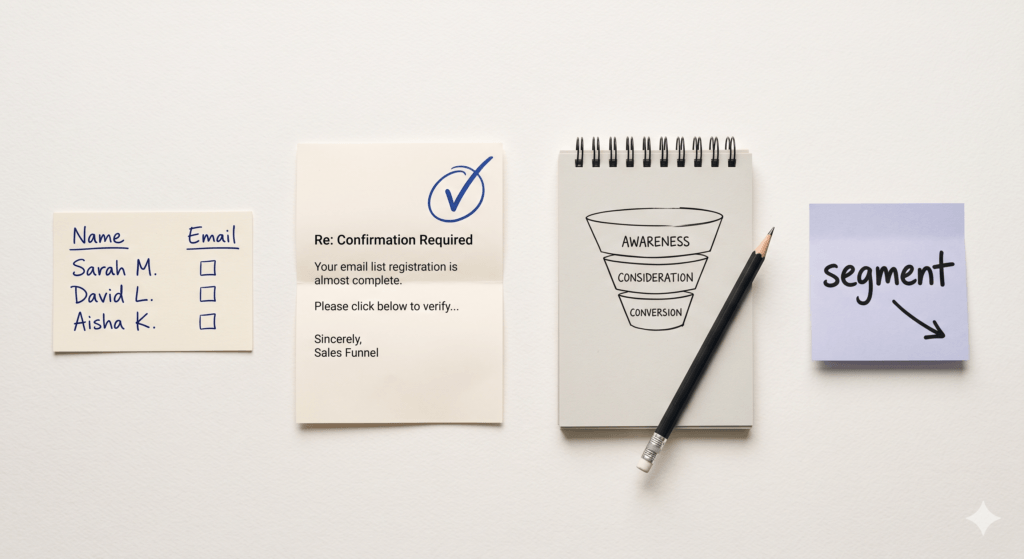
1. A lead magnet with specific utility
The single highest-leverage decision in list building is what you offer in exchange for an email address. Generic offers (“stay updated”, “join our community”) consistently underperform specific ones (“download our 5-page pricing calculator”, “get the checklist we use with every new client”).
The specificity of the lead magnet is a filter. A vague offer attracts vague subscribers. A precise, useful resource attracts people who have the specific problem that resource solves — and those are exactly the people most likely to buy what you sell.
When we audit small business email programs, the pattern is almost always the same: the businesses with the highest conversion rates from email to purchase have lead magnets that describe a specific outcome, not a content category. “Free marketing plan template for service businesses under £250k revenue” will always outperform “free marketing guide.”
2. Double opt-in to protect deliverability
Double opt-in requires a subscriber to confirm their email address before they join your list. It adds one step to the sign-up process — and that single step filters out bots, typos, and low-intent sign-ups in one move.
The result is a smaller list that reaches people who actually want to be on it. Mailchimp’s internal data shows that double opt-in lists consistently see higher open rates and lower spam complaint rates than single opt-in equivalents. For a small business where deliverability damage is hard to recover from, this is not optional.
One caveat worth naming: double opt-in can reduce your raw sign-up numbers by 20–30%. That feels uncomfortable when you’re watching the counter. It shouldn’t. Those lost sign-ups were people who either made a mistake or weren’t interested enough to click a confirmation email — neither of which was going to convert anyway.
3. A welcome sequence that earns the relationship
The welcome email is the most-opened email you will ever send. Open rates on welcome messages average 63.91% according to GetResponse’s 2025 Email Marketing Benchmarks — nearly double the average for standard campaigns. Most small businesses waste this window by sending one email that essentially says “thanks for subscribing, here’s your thing.”
A welcome sequence of 3–5 emails spread across the first 7–14 days does something different: it builds the relationship before making an ask. The sequence should introduce who you are and why your perspective is worth something, deliver the promised resource plus one thing they weren’t expecting, and only introduce your paid offer at email 3 or later — after you’ve already been useful twice.
The psychological principle at work is reciprocity. When you’ve given someone genuinely useful things before asking for anything in return, the ask lands differently. This is not a trick — it’s just the way trust is built offline, applied online.
4. Segmentation from the start
Segmentation means sending different emails to different groups of subscribers based on what they care about, where they are in the buying process, or how they behaved in your previous emails. It does not require sophisticated software — it requires a decision about which segments matter most to your business and a tagging system to track them.
For most small businesses, the two most valuable segments to start with are: subscribers who clicked a link in your welcome sequence (higher intent) and subscribers who haven’t opened in 60 days (re-engagement or removal candidates). Acting on just these two segments — with more targeted content for the first group and a re-engagement campaign for the second — can materially improve both deliverability and conversion rates within a single quarter.
See also: AI email personalisation for small businesses — how to automate segmentation and personalisation without a specialist.
How to build your email list: what actually works for small businesses
Most advice on list building focuses on tactics: pop-ups, content upgrades, social media CTAs, referral programmes. These all work — some better than others depending on your audience and context. What matters more is the principle behind them: every list-building tactic is a value exchange, and the quality of what you exchange determines the quality of subscriber you attract.
These four channels produce the highest-quality subscribers for small businesses with limited marketing resources:
- Your existing content. If you already publish a blog or create social content, the subscribers who arrive via content have already self-selected around a specific topic. A contextually placed sign-up offer within a blog post — “get the template we referenced above” — converts at meaningfully higher rates than a generic sidebar widget, because the subscriber already trusts that your content is useful.
- A specific lead magnet promoted at the point of highest intent. This means placing your sign-up offer where the reader’s problem is most acute: after they’ve read a post solving that problem, after they’ve watched a video about it, or via a paid social ad targeted at people actively searching for a solution. Timing the offer to intent, not just traffic, is the difference.
- Referral from existing subscribers. The simplest referral mechanism — “forward this to someone who’d find it useful” — consistently gets overlooked because it feels too simple. A small, engaged list of 300 people who refer actively is more valuable than a disengaged list of 3,000 who were acquired through a giveaway.
- Partnerships and co-marketing. A list swap or co-hosted webinar with a complementary business that serves the same customer type puts you in front of a warm, pre-qualified audience. These subscribers arrive with context about who you are, which compresses the trust-building phase.
What doesn’t work as well as it used to: purchased email lists. Beyond the legal exposure under CAN-SPAM (US) and GDPR (EU/UK), purchased lists carry a practical problem that no platform workaround solves — the people on them never asked to hear from you. Spam complaint rates from cold lists damage your sender reputation in ways that can take months to repair, and the conversion rates from cold email to paying customer for B2C small businesses are negligible.
Related: Free SEO tools for small businesses — including tools that can help you find the content gaps your email list-building strategy should fill.
What should you send? The 30-day sequence structure that builds trust and converts
Knowing how to build a list is half the problem. The other half is knowing what to send once someone is on it — particularly in the first 30 days, when the relationship is either cemented or quietly abandoned.

Below is the sequence structure Tabula uses as a starting framework for SMB clients, regardless of industry. It is not a template — it is a structure. Your version needs your voice, your specific value, and your specific offer. But the architecture is consistent:
Days 1–2: The welcome email
Send the promised resource immediately. Do not make them wait. Include one additional, unexpected thing — a tip, a link to your best-performing piece of content, a brief personal note about why you created the lead magnet in the first place. Keep it short. The only goal of email 1 is to deliver on the promise and establish that you over-deliver.
Days 3–5: The credibility email
This email exists to answer the question your subscriber is silently asking: “Why should I keep reading these?” Share one specific result, case study, or insight that demonstrates what you know. Not a testimonial page — a real story with a real outcome. “We worked with a retail client who reduced their email unsubscribe rate by 34% in six weeks by doing one thing differently” is credibility. “Our clients love us” is noise.
Days 7–10: The value email
Send something genuinely useful that requires no purchase. A framework, a checklist, a short how-to that solves a specific problem your subscriber is likely dealing with. This email has one job: to make the subscriber think “I’m glad I’m on this list.” That thought is the precondition for every future sale.
Days 14–21: The soft offer
By email 4, you’ve delivered real value three times. Now it’s appropriate to mention what you do and how it might help. The framing is not a hard sell — it’s a natural extension of the conversation: “If you’ve found these useful and want us to build this system for your business, here’s where to start.” Include a single, clear CTA. One offer, one link.
Days 25–30: The follow-up and feedback ask
Send a short email that does two things: invites a reply (“What’s the biggest marketing challenge you’re dealing with right now?”) and optionally reminds non-openers of the offer from email 4. Replies to this email are gold — they tell you exactly what your list wants to hear about next, which informs every piece of content you create for the next quarter.
What is a good open rate for small business email marketing?
A good open rate for email marketing depends on your industry, list age, and whether you’re measuring all subscribers or only engaged ones — but as a practical benchmark: a new, permission-based small business list should aim for 35–50% open rates in the first 90 days, declining gradually as the list grows and ages. If your list-wide open rate falls below 20%, you have a segmentation or deliverability problem that needs addressing before you invest more in list growth.
Click-through rates (the percentage of subscribers who click a link in your email) are a better indicator of engagement quality than open rates — especially since Apple’s Mail Privacy Protection feature inflated open rate data from 2021 onwards. A realistic click rate target for small business email is 2.5–5% on standard campaigns, rising to 8–12% for segmented, high-intent sends.
The most useful benchmark is not industry average — it’s your own previous send. A list that improves its click rate by 0.5% each month is outperforming a list that holds steady at a “good” industry average. Track the direction, not just the number.
Benchmark note: Mailchimp’s 2025 Email Benchmarks report median open rates ranging from 26.4% (e-commerce) to 47.1% (education and training). If your open rates are below your industry median, the most common causes are: sending too frequently to a list that hasn’t warmed to you yet, weak subject lines, or poor list hygiene (too many inactive subscribers dragging your average down).
The three email marketing mistakes that kill small business lists
Most email marketing problems are self-inflicted. These three mistakes account for the majority of underperforming lists we audit:
Sending to everyone, always
Broadcasting every email to your entire list is the fastest way to accumulate unsubscribes and spam complaints. When someone who signed up for a free SEO checklist receives an email promoting your social media management service, the disconnect signals that you don’t know what they care about — and you’re one irrelevant email away from losing them.
The fix is simple in principle: tag subscribers at the point of sign-up based on which lead magnet brought them in, and use that tag to shape what you send them. You don’t need a complex CRM to do this — Mailchimp, Kit (formerly ConvertKit), and ActiveCampaign all support basic tagging on free or low-cost plans.
Treating email as a broadcast channel instead of a conversation
Email is the only marketing channel where a subscriber can reply directly to you. Most small businesses either disable replies (by sending from a no-reply address) or never invite them. Both are missed opportunities. A subscriber who replies to your email is signalling high engagement — they are statistically far more likely to convert than one who only opens.
Inviting replies — “hit reply and let me know what you think” — is one of the highest-ROI, lowest-effort things you can do in email marketing, and it also improves your deliverability because email providers weight sender-subscriber conversation history as a positive signal.
Neglecting list hygiene
Every email list naturally accumulates inactive subscribers over time. A subscriber who hasn’t opened your emails in 6 months is not a neutral asset — they actively harm your deliverability by dragging down your engagement rate, which major inbox providers use to decide whether future emails from you land in the inbox or in spam.
The standard practice is a re-engagement campaign at the 90-day mark for subscribers who haven’t opened anything: send 2–3 emails specifically designed to re-activate them, and remove anyone who doesn’t respond. Cutting inactive subscribers feels counterintuitive when you’ve worked hard to build the list — but a smaller, more engaged list reaches the inbox more reliably and converts at a higher rate.
Related: How to measure AI marketing ROI for your small business — including how to track email marketing’s contribution to revenue alongside other channels.
The list is only as good as the relationship behind it
Every high-converting email list was built the same way: by earning the attention of the right people, delivering real value before making an ask, and treating the inbox as a relationship channel rather than a broadcast platform. Size is a consequence of doing those things well — not the starting point.
The businesses that generate consistent revenue from email marketing are not the ones with the biggest lists. They’re the ones who know exactly who they’re talking to and exactly what that person needs to hear at each stage of the relationship. That precision is achievable at any list size — you don’t need 10,000 subscribers to run email marketing that works.
If you’ve been meaning to get your email marketing properly set up but keep putting it off because it feels complicated, it’s worth knowing that the fundamentals above can be implemented in a single afternoon. The hard part isn’t the technology — it’s making the decision to prioritise relationship over reach.
Find out what’s holding your marketing back
Book a free AI Marketing System Audit. In 30 minutes, we’ll review your current email setup, identify the gaps, and show you exactly what a converting list looks like for a business like yours.

Author
Carlos Rios
Carlos Rios is the Founder of Tabula. Before starting the agency, he spent his career inside companies — reporting to leaders who had no patience for vanity metrics and wanted straight answers about what was working and why. He built Tabula around that same standard: a marketing system the client owns, powered by AI and led by experts who explain the plan in plain language. Carlos studied philosophy for six years at York University and holds a Master's in Marketing from the Schulich School of Business.