








In this article6 sections
You’ve probably seen posts calling Google’s new Preferred Sources button an SEO win. For an online store, it mostly isn’t. The button lets a reader save your site as a source they want to see more often. That changes what that reader sees, not your rankings for everyone else. It helps a blog with returning readers. On product and category pages, it barely matters. Add it to your blog, not your store.
What does the Preferred Sources button do?
Google released an embeddable version of the button on August 20, 2026. A reader clicks it, your site is saved as one of their preferred sources, and they land back on your page. Before, they had to leave for a Google settings page.
For readers who opt in, Google’s documentation says your content is more likely to appear in Top Stories, with a “preferred” badge. Preferred sources also carry that badge in AI Overviews and AI Mode. Google says people are twice as likely to click through to a preferred source. That figure is Google’s own, so treat it as a claim, not a benchmark.
Who does it actually help?
Sites that publish fresh content and have readers who come back. Google’s help page says preferred sources appear more often in Top Stories when they publish fresh content related to the search, and that sources not updated regularly may not be available to select. An active blog or a set of buying guides fits. A product page untouched for a year does not.
Google reports readers have selected more than 600,000 sources, up from more than 345,000 in May. It doesn’t say how many readers made those picks, so the number says little about how many of your buyers will click.
Where should e-commerce brands put the button?
At the end of your articles and buying guides, right after the reader got something useful. Leave it off product and category pages.
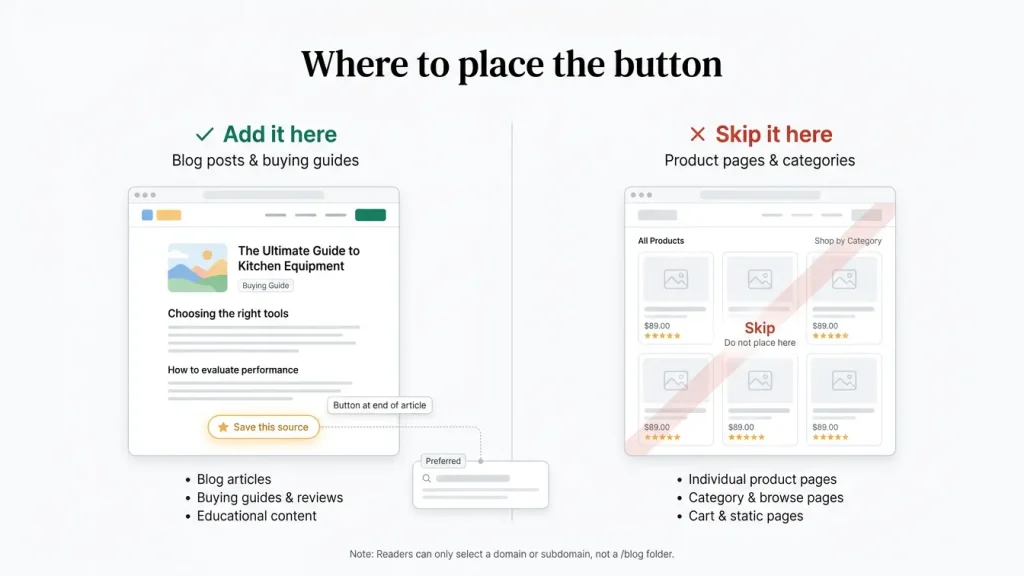
Two setup facts from Google’s documentation matter here. First, only a domain or a subdomain can be selected, not a subfolder such as /blog, so the button adds your site, not just the blog. Second, to show as a preferred source in AI Overviews and AI Mode, your site must be included in Search generative AI features in Search Console. Check that setting before you add anything.
How do you measure whether it works?
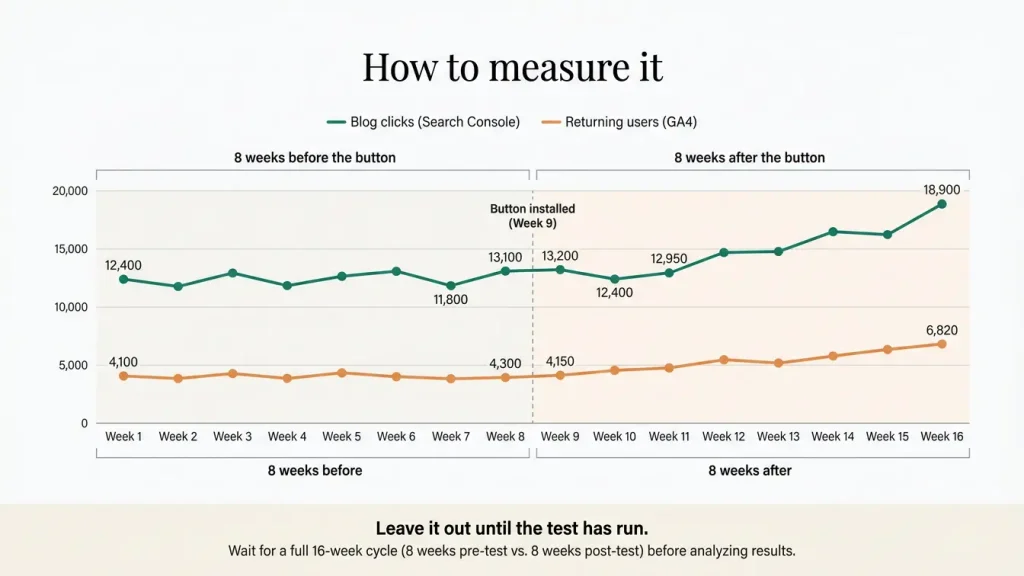
Track clicks and impressions for your blog URLs in Search Console, and returning users in GA4. Give it about 8 weeks, then compare against the 8 weeks before the button went live. Expect small numbers.
Who should skip it?
Stores with no blog, a blog that publishes a few times a year, or a site made of static pages. The button also guarantees nothing. Google’s documentation says its methods are ways to build an audience, and that you don’t need them to appear as a preferred source.
Where does this fit in getting found?
Being found on Google and recommended in AI answers like ChatGPT, Gemini and Perplexity still starts with clear product pages and trusted sites talking about you. That is the core of e-commerce SEO, and it’s what GEO builds on, which means getting recommended in AI answers.
The button adds a loyalty layer for readers you already have. If buyers can’t find your store on Google today, a button won’t fix that. Fix that first, then add it once your blog has readers worth keeping.
Not sure buyers can find your store?
Get your Free AI Visibility Report and see whether ChatGPT, Gemini and Perplexity name you, and who they name instead.