
B2B Ecommerce SEO: Why Your Best Pages Are Invisible to Google

Your best pages are invisible because the two things that make a B2B catalog valuable are the same two things that keep it out of the index. Pricing and specifications sit behind a login, so Google never sees them. The pages that are public carry product descriptions supplied by the manufacturer and reproduced word for word by every competing distributor, so Google sees them and has no reason to prefer yours.
That is the problem, and it is architectural rather than editorial. No amount of blog content fixes it.
It also goes largely unsaid. Search this topic and most of page one is published by the commerce platforms themselves, or by agencies that build on them. Neither has commercial reason to point out that the default templates are a large part of the cause.
B2B ecommerce pages go missing from search for five structural reasons: the catalog is gated at page level instead of field level, product copy is duplicated from the manufacturer across every distributor, category pages contain nothing but a product grid, faceted navigation consumes the crawl budget before Google reaches the products, and no pages exist for the part numbers buyers actually search. Fix those five before commissioning any content.
What is B2B ecommerce SEO, and how is it different from B2C?
B2B ecommerce SEO is the practice of making a business-to-business catalog findable and credible in search, under conditions where pricing is restricted, product data is shared across competitors, and buying decisions involve several people over months.
The tactics look identical to B2C. Category pages, product pages, structured data, internal linking, speed. The constraints do not. A B2C store wants every product page public, priced and indexed. A B2B distributor often cannot publish contract pricing, may be contractually restricted on certain product data, and sells the same SKU as forty competitors using the same supplied copy.
That makes a B2B ecommerce SEO strategy a set of architectural decisions about what sits in front of the login and what the public version of a restricted page contains. Keyword research is the easy part.
Why does gated pricing make your product pages invisible?
Because the gate is applied to the page instead of to the price field. If the whole product page requires authentication, Google indexes a login prompt. If only the price requires authentication, Google indexes a complete product page and the buyer still has to register to transact.
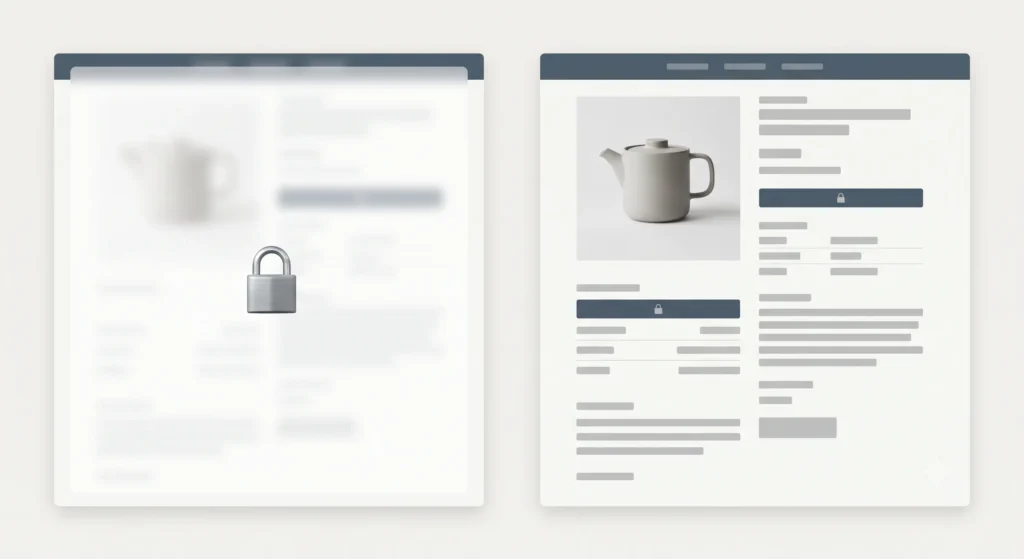
The distinction sounds minor and it decides whether a catalog exists in search at all.
The pattern is consistent. A distributor launches a new platform, sets the catalog to members-only because that is how the sales team has always worked, and six months later reports that organic traffic never recovered from the replatform. The migration did not cause the drop. Moving the catalog behind a wall did.
What should live in front of the login?
Product name, manufacturer part number, manufacturer name, specifications, compatibility and cross-reference data, application guidance, datasheets, and a clear quote or account-request path. All of it helps a buyer shortlist you, and almost none of it is commercially sensitive.
Datasheets and application guides deserve a second look, because most distributors file them as product documentation and nothing else. They are also among the strongest B2B lead magnets available to you, already written and already paid for.
Behind the login: contract pricing, tiered volume pricing, negotiated terms, live stock by warehouse, order history. Price is usually the only field that genuinely needs protecting, and hiding one field does not require hiding the page.
What happens when your product copy is the manufacturer’s copy?
The page gets indexed and stays invisible, which is a different failure from the one above. Google can see it. It has no reason to rank your version ahead of the thirty-nine identical versions published by everyone else selling the same SKU.
You do not solve this by rewriting every product. On a 15,000-SKU catalog that is not a project, it is a fantasy.

Tier it instead. Write genuinely original content for the few hundred products that drive revenue: application context, what they replace, common failure modes, what buyers get wrong when specifying them. For the long tail, differentiate at scale using data you already hold and competitors do not, such as cross-reference tables, compatibility matrices and in-house fitment notes.
For products that will never earn a ranking and exist only so the catalog is complete, stop trying. Keep them crawlable and linked, treat them as inventory rather than content, and move the budget somewhere it can work.
Google’s duplicate content guidance is worth reading directly rather than through an agency summary, because the practical instruction (consolidate with canonicals, do not spin text) is consistently misrepresented.
Why do B2B category pages have nothing for Google to rank?
Because the page is a product grid with a 40-word introduction, and the products belong to everybody.
Category pages match how buyers search early in the process, which makes them the highest-value pages on most B2B sites and the ones platform templates handle worst. A category page that ranks contains an actual answer alongside the grid: what the category is, how the products differ, which specification matters for which application, and what to check before ordering.
The test takes ten seconds. Remove every product tile from the page. Is anything useful left? If not, there is nothing there to rank except products your competitors also list.
Where does your crawl budget actually go?
Into filter combinations, usually. Six filters with eight values each can generate more indexable URLs than the site has products, and Google will spend its crawl allocation on them before it reaches the pages you care about.
Decide which facet combinations represent real search demand, normally one or two such as brand plus category or specification plus category, and make those indexable with their own titles and copy. Block or canonicalise everything else. This is an architecture decision made once, and it costs less than the content work teams commission instead when rankings fail to appear.
Why don’t you rank for the part numbers buyers search?
Usually because those pages were never built, and they were never built because keyword research said there was no demand.
B2B buyers search exact manufacturer part numbers, and competitor part numbers they are trying to cross-reference. Neither shows meaningful volume in any tool, because the demand is spread across tens of thousands of individually tiny queries. A standard research process returns nothing and concludes there is nothing there.
This is the highest-intent traffic available in B2B ecommerce. A buyer searching an exact MPN has already specified the product. A buyer searching a competitor’s part number is actively looking to switch supplier. The pages that serve them are cheap to build, because the data already sits in your product information system.
Are you invisible in AI search too?
Yes, and for the same reason. Procurement teams use AI assistants to build vendor shortlists, and an assistant cannot cite a page it cannot read. A catalog Google cannot crawl is absent from every retrieval layer built on top of it.
The mechanics are not separate from SEO. The same clarity, structure and entity consistency that earn organic rankings are what surface a supplier in a generated answer, which is why generative engine optimisation sits on top of technical SEO rather than replacing it. The one difference worth acting on is specification-level content, because AI answers frequently address comparison and compatibility questions that a traditional product page never answered in text.
Who owns your taxonomy, schema and URL structure?
Ask now, because replatforming without your redirect map is how a visible catalog becomes an invisible one overnight.
Your category taxonomy, URL structure, internal linking logic, redirect map and structured data are assets. They hold years of accumulated ranking equity and they are portable. If your agency or platform partner built them inside a proprietary system and holds the documentation, you are not renting a service, you are renting your own search presence back.
This is the same problem the Marketing Ownership Framework describes across the wider marketing stack, and it is sharper in B2B commerce because the assets are larger and the replatforming cycle is shorter than most operators expect.
Before the next build, ask for the taxonomy documentation, the redirect map and the schema templates in a format you can hand to a different vendor. If that request is awkward to fulfil, you have your answer.
The B2B ecommerce SEO checklist you can run this quarter
- Confirm what proportion of your catalog is crawlable without authentication, using a crawler set to ignore cookies
- Separate the price field from the page gate, so product data is public and pricing is not
- Identify your top 200 revenue SKUs and audit whether their descriptions are original or supplier-supplied
- Map which faceted URL patterns are indexable and block the rest
- Check that manufacturer part numbers appear in page titles, H1s and on-page text, not only inside a spec table image
- Build cross-reference pages for the competitor part numbers your sales team hears most often
- Confirm Product schema is present with accurate availability, and that restricted pricing is omitted rather than falsified
- Request your taxonomy, redirect map and schema documentation in a portable format
Run these before commissioning any content programme. Content built on a catalog Google cannot crawl is spend with nothing underneath it.
The one thing to take away
Your best pages are invisible for structural reasons, not editorial ones. Before hiring anyone to write product copy or build links, find out how much of your catalog a search engine can actually reach, and who holds the documentation for the architecture underneath it. Those two answers set your organic ceiling more than any keyword report will.
Find out how much of your catalog Google can actually see
We run a crawl against your live site, ungated and unauthenticated, and show you exactly which products exist as far as search is concerned.
FAQ
How do you choose a B2B ecommerce platform for SEO?
Judge platforms on what they let you control rather than on the feature list: URL structure, canonical handling, faceted navigation rules, schema templates, and whether you can export your taxonomy and redirect map in a portable format. A platform that handles those well but looks plainer will outperform one that does not.
Can you use Product schema if your pricing is hidden?
Yes. Mark up everything you can verify, including name, part number, brand and availability, and omit the price rather than inventing one. Placeholder or zero values inside an Offer block are a structured data violation and put you at risk of a manual action. Omission is safe; false data is not.
How do you measure B2B ecommerce SEO when the conversion is a quote, not a sale?
Track quote requests, account registrations, datasheet downloads and logged-in session starts as separate goals, then tie them back to closed revenue in your CRM. Organic revenue reported in an analytics platform will understate B2B performance badly, because the transaction usually happens offline weeks later.
Should you run separate sites for B2B and B2C if you sell both?
Usually not. Two sites split your authority, duplicate your product data and double the maintenance. A single domain with gated B2B pricing, separate account types and distinct category paths keeps the ranking equity in one place. Separate sites make sense only when the two catalogs barely overlap.
How long does B2B ecommerce SEO take to show results?
Architectural fixes such as ungating product data or resolving faceted URL bloat can move impressions as soon as the site is recrawled. Rankings and revenue move far more slowly, because B2B buying cycles run for months. Judge early progress on indexed page count and impressions, not on orders.

Author
Carlos Rios
Carlos Rios is the Founder of Tabula. Before starting the agency, he spent his career inside companies — reporting to leaders who had no patience for vanity metrics and wanted straight answers about what was working and why. He built Tabula around that same standard: a marketing system the client owns, powered by AI and led by experts who explain the plan in plain language. Carlos studied philosophy for six years at York University and holds a Master's in Marketing from the Schulich School of Business.