
Father’s Day Marketing for Small Businesses: Run It in 2 Weeks with AI

Father’s Day lands on June 21, 2026. If you haven’t started your marketing campaign yet, you’re not behind — but you will be by Friday if you wait any longer. The good news: with the right AI tools and a clear two-week system, a small business with no dedicated marketer can run a fully coordinated Father’s Day campaign across email, social media, and in-store or online promotions.
Most small businesses either skip holiday campaigns entirely or scramble into generic “Happy Father’s Day” posts that generate zero revenue. The businesses that actually convert during Father’s Day treat it as a revenue window, not a greeting card opportunity. They plan in layers: awareness content first, then offer-led content, then last-chance urgency. And in 2026, AI handles the heavy lifting — copy drafts, content calendars, email sequences, and social post variations — in a fraction of the time it once took.
This guide gives you a complete, day-by-day two-week marketing playbook for Father’s Day. Every tactic is built for a small business running lean — no agency, no full-time marketing team, no six-figure ad budget required.
Father’s Day (June 21) is a high-intent gifting window worth capturing even with two weeks to go. The winning approach: spend Week 1 on awareness and offer setup, Week 2 on urgency and conversion. Use AI tools to generate your email sequence, social captions, and promotional copy in under two hours. The single biggest mistake SMBs make is starting promotional content on the day itself — by then, 70% of Father’s Day purchases are already decided. Start now.
Why Father’s Day Is Worth Prioritizing as a Small Business?
Father’s Day consistently ranks among the top five consumer spending occasions in the United States. The National Retail Federation reported that total Father’s Day spending reached $22.9 billion in 2023, with the average person spending $196.23 — up from $171.79 the previous year. Gift cards, experiences, and clothing dominate spending categories, but restaurants, local experiences, and independent retailers capture a meaningful slice when they market proactively.
For small businesses, the window is tighter than for retailers with national reach — but the buying intent is high and the competition from other local or niche businesses is often low. A well-timed, well-structured two-week campaign is enough to drive measurable revenue impact, even for businesses that have never run a holiday marketing push before.
The key insight most small business owners miss: Father’s Day is not a one-day event. It is a two-week decision-making process. Research begins in early June, gift purchases cluster between June 5–12, and last-minute buyers (a substantial cohort) shop June 13–14. A campaign that begins now, structures content by intent stage, and activates urgency in the final 72 hours will capture buyers at every point in that window.
What AI Actually Does in a Small Business Holiday Campaign?
AI tools do not replace your judgment or your understanding of your own customers. What they remove is the friction between having a marketing idea and executing it.
In a typical Father’s Day campaign, the tasks that consume the most time are not strategic — they are executional. Writing five variations of an email subject line. Drafting three versions of a social caption. Creating a promotional offer description that sounds compelling but not desperate. Building a posting schedule that accounts for platform-specific timing. These are exactly the tasks where AI tools like ChatGPT, Claude, and Gemini produce strong results with minimal input.
The Tabula Build → Run → Train → Own model applies directly here. A small business using AI for a Father’s Day campaign is not just running a campaign — it is building a reusable system. The prompts you write this week, the templates you create, and the campaign structure you follow will work for Mother’s Day, Back to School, and every other seasonal window going forward. You do the setup once; the system runs on its own.
The 2-Week Father’s Day Campaign Framework
This framework assumes you are starting approximately two weeks before Father’s Day. If you have less time, the structure still applies — compress Week 1 into your first two to three days, and run Week 2 tactics across the remaining window.
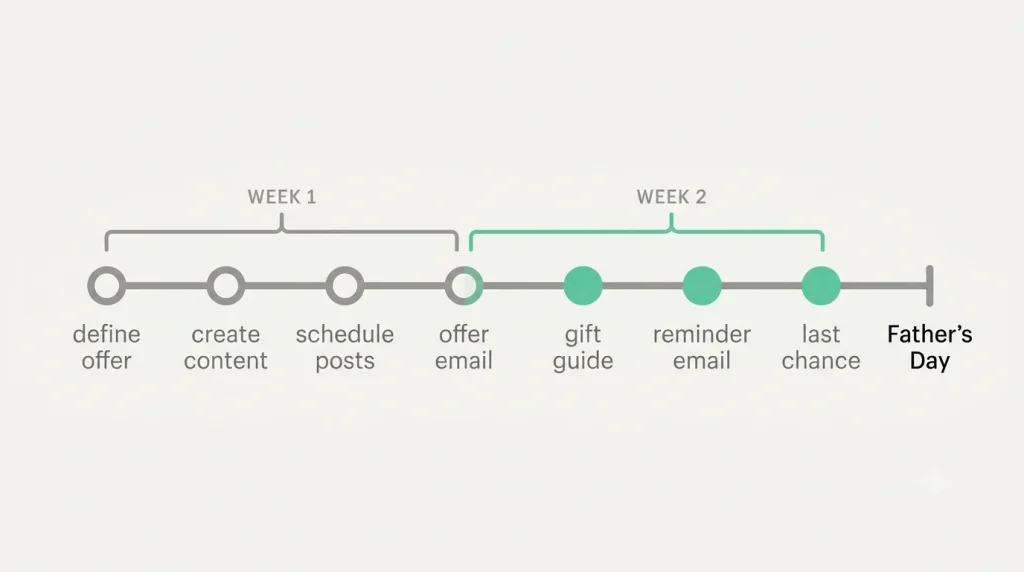
Week 1: Build Awareness and Set Up Your Offer
The first week of a holiday campaign is about visibility, not conversion. You are not asking people to buy yet — you are putting your business in front of the right people and making them aware that you have something worth coming back for.
Day 1–2: Define your Father’s Day offer. This can be a product bundle, a gift card promotion, a service package, a dining special, or simply a curated recommendation from your existing inventory. The offer does not need to be complex — it needs to be specific. “20% off everything” is forgettable. “Give Dad a day he’ll actually remember — here’s what we’d pick” is memorable.
Day 3–4: Create your content assets. Use an AI tool with this prompt:
“Write three social media captions for [your business type] promoting a Father’s Day offer. Tone: warm, direct, not sentimental. Each caption should be under 150 characters and end with a clear action. Offer: [describe your offer]. Target: people buying a gift for their dad or husband.”
Generate captions for Instagram, Facebook, and any other platforms you use actively. Run this prompt three times with slight variations — gift-giver angle, dad-as-recipient angle, and last-minute-shopper angle. You will have nine usable captions in under 20 minutes.
Day 5–7: Schedule Week 1 posts. Aim for three to four posts across the week — one awareness post introducing your Father’s Day angle, one product or offer highlight, one piece of social proof or storytelling content (a customer review, a behind-the-scenes moment, a “what we’d recommend for different types of dads” post).
Week 2: Drive Urgency and Convert
Week 2 is where holiday campaigns either win or waste their first-week effort. This is the conversion phase — and it has a clear structure.
Day 8–9 (June 6–7): Send your first email campaign. This is your offer email — clear subject line, specific offer, clean CTA. Use an AI tool to generate three subject line options, test them if your email platform supports it, or choose based on your own read of your audience. A strong subject line for this send: specificity over cleverness. “Your Father’s Day plan, sorted” consistently outperforms “🎉 Father’s Day is coming!” for small business email lists.
Day 10–11 (June 8–9): Deploy your engagement content. This is where a “gift guide” or “which experience suits your dad” style post earns high reach on social. Lists and recommendations are the most-shared Father’s Day content format — not because of the algorithm, but because people tag their partners or forward them as buying suggestions. Keep it focused: five to eight options, clearly described, with a direct link to purchase or book.
Day 12 (June 10): Send your second email. This is the reminder-and-social-proof email. Feature a customer review if you have one, or a specific product story. Subject line: “Still looking for the right Father’s Day gift?” This captures the research-mode buyer who saw your first email but didn’t act.
Day 13–14 (June 11–12): Run your urgency posts. “Order by [date] for guaranteed delivery” if you ship. “Last bookings available” if you offer experiences or services. “Grab a gift card — no deadline, no hassle” if you want a zero-friction option. These posts do not need to be elaborate. They need to be specific, honest, and timely.
June 13–14: Send your last-chance email. This is the most-opened email in any holiday campaign. Subject line: “Father’s Day is Sunday — last chance to [action].” Keep the email short: two sentences of context, one clear offer, one link. That is it.
Email Marketing for Father’s Day: What Actually Works
Father’s Day email campaigns consistently outperform general promotional emails on open rate — not because people love holiday emails, but because the subject matter is personal. A well-timed email that solves the gift problem for someone who is mildly stressed about it will get opened.
The three email types that drive results in a two-week Father’s Day campaign:
- The Offer Announcement email goes out 10–12 days before. It introduces your Father’s Day promotion, describes the offer specifically, and gives a clean path to purchase. Keep it under 150 words. Use one image. One CTA button.
- The Social Proof email goes out 5–7 days before. It features a real customer review, a “what we’d recommend” section, or a story about the product or experience from your own perspective. This email builds trust, not urgency. People who received the first email but did not act often respond to this one.
- The Last-Chance email goes out 2 days before. Subject line includes the date. Body is short. Offer is repeated clearly. CTA is prominent. If you sell physical products, include any shipping cutoff or gift card alternative prominently.
Use an AI tool to generate subject line options for each email using this structure:
“Write five email subject lines for a [email type] Father’s Day email from a [business type]. The tone should be [warm/direct/urgent]. The offer is [describe offer]. Do not use exclamation marks excessively. Avoid generic phrases like ‘celebrate dad’ or ‘show him you care.'”
This prompt structure consistently produces more usable options than open-ended requests because it gives the AI a specific constraint — your business type, the email function, and the tone — rather than leaving it to default to generic holiday language.
Social Media Content for Father’s Day: Platform-Specific Guidance
Father’s Day social content follows a clear pattern across platforms. The format that gets the most organic reach is the recommendation list — “5 gifts for the dad who says he doesn’t want anything,” “The best local experiences for Father’s Day,” “If your dad is into [X], here’s what we’d suggest.” These posts earn shares and saves because they solve a real problem for the person reading them.
Instagram rewards visual storytelling for Father’s Day. A product flat lay or a behind-the-scenes reel of how your team prepares a Father’s Day special outperforms a generic graphic with “Happy Father’s Day” in large text. Reels under 30 seconds with a clear hook in the first two seconds perform best in the June window. If you need help building a consistent social media content system beyond a single campaign, Tabula’s organic social media services are built around exactly this kind of always-on content engine for SMBs.
Facebook still drives meaningful reach for local small businesses during holiday periods, particularly for the 35–55 demographic most likely to be buying Father’s Day gifts. Event posts combined with boosted offer posts on June 10–12 give the best return on a small paid social budget. If you are not running paid social, organic posts with product links and a direct CTA still work — but comment engagement in the first 30 minutes after posting is critical for organic reach.
For email-social coordination: post your offer on social the same day you send the email. Consistency across channels reinforces the message. A customer who sees your email, ignores it, then sees the same offer on Instagram two hours later is far more likely to click the second time than someone who only encountered it once.
How to Audit Your Father’s Day Campaign Performance in Real Time
A two-week campaign is short enough to adjust mid-run if you know what to track. For email: open rate and click-through rate are your core metrics. If your first email has an open rate below 20%, your subject line missed — test a different angle on the second send. If open rate is strong but CTR is low, the offer or the CTA in the email body needs work.
For social: reach and saves are the leading indicators that matter for gift recommendation content. Comments and shares signal amplification. If a post is getting saves without clicks, you have content people value but a CTA that is not compelling enough — adjust the caption on your next post.
Use Google Search Console to check if any Father’s Day or gift-related queries are driving impressions to your site during the campaign window. If you see queries with impressions but near-zero clicks, your page title and meta description are not matching the searcher’s intent — update them. For the technical and content signals that affect how your pages perform in both search and AI tools, the Tabula guide on how to write a blog post that actually ranks on Google covers the core framework. If you want a full technical audit of your site’s current SEO setup, Tabula’s professional SEO services include an AI-powered site audit as the starting point.
The AI Prompt Library: Copy-Paste Templates for Your Campaign
These prompts are written for ChatGPT, Claude, or Gemini. Paste them directly, replace the bracketed fields with your specifics, and use the output as a starting draft — not a finished product. Edit for your voice and your customers.
Email Subject Lines
Write 5 subject lines for a Father’s Day email from a [type of business — e.g. craft brewery / florist / restaurant / fitness studio]. The email promotes [describe your offer]. Tone: direct, no excessive exclamation marks, no clichéd Father’s Day language. Audience: people buying a gift for their dad or partner.
Social Media Captions (Gift Guide Style)
Write a social media post for [platform] positioning [your business] as a Father’s Day gift option. Format it as a short gift recommendation — not a hard sell. Include 1 specific detail about what makes this option memorable or different. Under 200 words. End with a soft CTA. No hashtag spam.
Last-Chance Email Body
Write a last-chance Father’s Day email for [type of business]. The email should be under 100 words. Lead with the date — “Father’s Day is this Sunday.” Describe the offer in one sentence. Give the CTA in one sentence. Do not use urgency language that feels manufactured (“Don’t miss out!”). Keep it human.
Common Father’s Day Marketing Mistakes Small Businesses Make
Starting promotional posts on the day itself is the most common and most costly mistake. By Father’s Day morning, the majority of gift decisions have already been made. Your content on June 15 will reach people who are either already buying or not buying at all. The campaign window is June 1–13; everything after that is last-chance messaging, not primary acquisition.
Using generic creative that does not reflect your brand or your customers. “Happy Father’s Day from [Business Name]” with a stock photo of a smiling man in a barbecue apron is not marketing — it is noise. Your Father’s Day content should reflect what your business actually offers and what your specific customers actually buy. Specificity is the difference between content that gets saved and content that gets scrolled past.
Treating Father’s Day as a single channel campaign. Businesses that coordinate email and social consistently outperform those that use either channel alone. The reason is simple: message repetition across channels builds familiarity and urgency simultaneously. The customer who sees your email on Monday and your Instagram post on Wednesday and your Facebook reminder on Friday is in a very different buying state by Friday than someone who only saw Monday’s email.
Not having a clear landing page or purchase path for the campaign. If your Father’s Day social post drives traffic to your homepage with no clear next step, you will lose the buyer. Every campaign needs a destination — a specific product page, a booking link, a gift card page, or a landing page that matches the offer in your creative. For small businesses building or improving their web presence, Tabula’s web development services include building conversion-focused landing pages designed for exactly this kind of campaign use case.
How Tabula Builds Father’s Day Campaigns for SMB Clients
The campaigns described in this guide are not theoretical. They reflect the system Tabula builds and runs for small and medium-sized businesses that want their marketing to work without requiring them to become marketers.
The Build phase creates the campaign framework: offer definition, content calendar, email sequence structure, and AI prompt library tailored to the business. The Run phase executes across channels — copy, scheduling, and coordination handled end-to-end. The Train phase documents the system so the business team can run future seasonal campaigns independently. The Own phase is where the business has a repeatable holiday marketing system that operates without outside help.
If you want a Father’s Day campaign built and running in the next 48 hours without doing it yourself, the free AI Marketing System Audit is the starting point. It takes 30 minutes and gives you a clear picture of where your current marketing setup has gaps — and what a system approach would look like for your specific business.
Start Today, Not Monday
The businesses that win Father’s Day are not the ones with the biggest budgets or the most creative teams. They are the ones that start early enough, plan in stages, and execute consistently across two weeks. With AI handling the copy generation and a clear daily framework to follow, two weeks is more than enough time to run a full campaign from zero.
Father’s Day is June 15. You have the system. What you build with it this week will be running next holiday season too — because a system, once built, does not need to be rebuilt from scratch.
Get Your Free AI Marketing System Audit
Tell us what you’re currently doing for seasonal marketing — we’ll show you exactly where the system gaps are and what an AI-powered approach would look like for your business.

Author
Carlos Rios
Carlos Rios is the Founder of Tabula. Before starting the agency, he spent his career inside companies — reporting to leaders who had no patience for vanity metrics and wanted straight answers about what was working and why. He built Tabula around that same standard: a marketing system the client owns, powered by AI and led by experts who explain the plan in plain language. Carlos studied philosophy for six years at York University and holds a Master's in Marketing from the Schulich School of Business.