
Why Your SMB Blog Gets No Traffic: The 2026 AI-Era Diagnosis

Your blog exists. You publish. And almost nothing comes back, no clicks, no leads, no sign that anyone found it. This is not a content quality problem. It is a structural diagnosis problem.
In 2026, SMB blogs fail for one of six reasons and most owners misdiagnose which one is killing them. They write more posts, tweak headlines, or wait for Google to “catch up.” Meanwhile, the real culprits go untreated.
This guide walks through the complete 2026 diagnostic: what has changed in how Google and AI tools surface content, what the data says about why SMB blogs stall, and what the systems fix actually looks like step by step.
If you have published 10+ posts, are not seeing organic growth after 4–6 months, and your Google Search Console shows impressions but near-zero clicks you are in the right place.
What No Traffic Actually Means in 2026?
Before diagnosing, define the problem correctly. No traffic is not one thing, it is three distinct failure states, each requiring a different fix:
- Zero impressions in GSC. Google has not indexed your pages, or has indexed them and deemed them not relevant enough to surface for any query. Root cause: technical indexing failure or severe topical mismatch.
- High impressions, near-zero clicks. Google is showing your content at position 8–20 but nobody clicks. Root cause: CTR failure — your title and meta description are not competing at the ranking position you hold.
- Impressions collapsing after initial spike. You ranked briefly, then dropped. Root cause: Google tested your content against user behaviour signals (dwell time, pogo-sticking) and downgraded it.
Each failure state has a different treatment protocol. The diagnostic below will tell you which one — or which combination applies to your blog.
Related: Why Your Website Is Not Showing Up on Google
The 2026 Search Environment: What Has Changed for SMB Content
Three structural shifts have made SMB blogging significantly harder since 2024 and most advice online predates all three.
AI Overviews are absorbing informational traffic
Google’s AI Overviews now appear for a large share of informational queries, the exact category where most SMB blog content lives. When an AI Overview answers the question directly on the results page, click-through rates on organic results below it collapse. The traffic does not go elsewhere. It simply disappears.
This does not mean informational content is worthless. It means the content needs to be the source that AI Overviews cite, not a result that sits below one. That requires a fundamentally different content structure.
Deep dive: How AI Overviews Are Impacting Website Traffic (And What to Do About It)
E-E-A-T requirements have tightened for SMB sites
Google’s quality evaluator guidelines weight Experience, Expertise, Authoritativeness, and Trust more heavily than in previous years particularly for YMYL-adjacent content (financial decisions, business decisions, marketing investment).
A blog with no identified author, no byline credentials, and no demonstrable first-hand experience will be outcompeted by sites that have these signals, even if the content is technically similar.
For a new or migrated domain like tabula.agency, explicit E-E-A-T signals are not optional — they are the mechanism through which Google assigns ranking trust to a domain that has no legacy performance data.
Zero-click search and answer engine competition
ChatGPT, Perplexity, Gemini, and Claude now answer the queries that used to drive blog traffic. For an SMB blog to earn organic reach in 2026, it must compete in two arenas simultaneously: traditional Google organic results and AI answer engine citations. These require overlapping but distinct content signals a topic covered later in this guide.
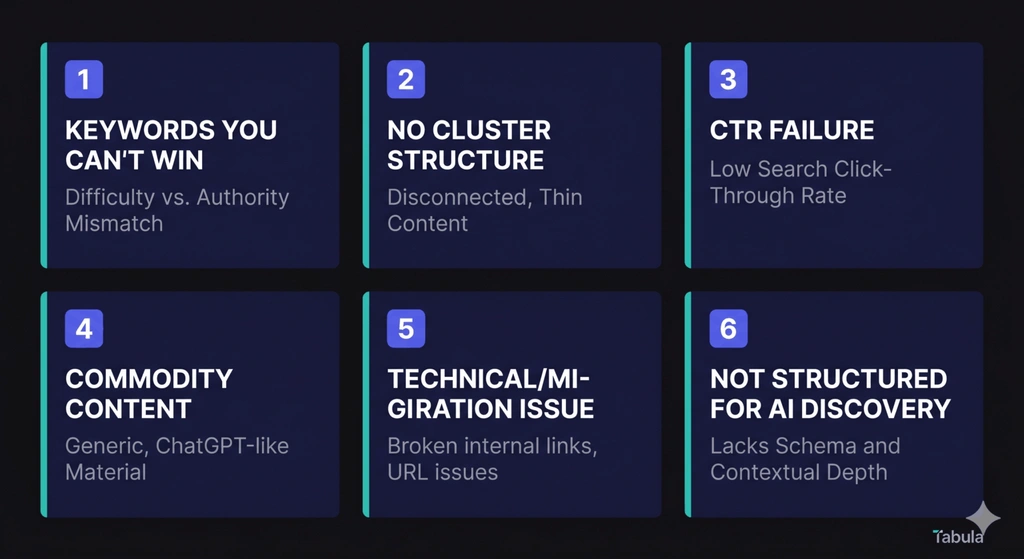
The Six Reasons Your SMB Blog Gets No Traffic
1. You Are Targeting Keywords You Cannot Yet Win
Keyword difficulty is not abstract, it is a measure of the domain authority and backlink profiles of the pages currently ranking for a query. A new or recently migrated domain with an Authority Score of 2–5 cannot compete for keywords with a KD of 50+, regardless of content quality. The result: your pages are indexed, they appear in GSC impressions at positions 40–80, and no one ever sees them.
The fix is not to write better content for those keywords. It is to build a keyword strategy that starts with low-competition, high-specificity terms where topical depth and content quality can actually win, then builds toward competitive terms as domain authority increases.
Related: How to Write a Blog Post That Actually Ranks on Google
2. Your Content Has No Topical Cluster Structure
Google rewards topical authority the demonstrated depth of coverage across a subject. A blog with 20 posts across 20 unrelated topics has less topical authority on any single topic than a blog with 8 posts that systematically cover one subject from multiple angles.
Most SMB blogs are built on the publish anything model: post ideas get executed in isolation with no linking strategy, no pillar architecture, and no deliberate topical cluster build. Google sees a site with broad surface coverage and shallow depth, and assigns limited ranking authority to any individual post.
The structural fix: identify 3–5 core topics your business can genuinely own, build pillar content for each, and create supporting cluster posts that interlink systematically. Every post should strengthen the topical authority of the cluster it belongs to.
3. Your Titles and Meta Descriptions Are Not Built for CTR
High impressions with low clicks, the most common pattern in SMB Google Search Console data is a CTR problem, not a ranking problem. You have earned a position on page one or two. The issue is that your title is not compelling enough to earn the click over the results above and below you.
CTR is determined by four factors: the title clarity of promise, its specificity (numbers, timeframes, named outcomes), its alignment with search intent, and its emotional or informational relevance. Generic titles like 10 Marketing Tips for Small Businesses lose to titles that name the specific problem, promise a specific outcome, or create genuine curiosity.
Related: How to Do a DIY SEO Audit for Your Small Business
4. Your Content Is Commodity — It Matches What Already Ranks
If your post covers the same points in the same order as the posts currently ranking for your target keyword, you are not competing you are producing a slightly worse version of existing content. Google has no reason to elevate a new entry that does not add something absent from current results.
Non-commodity content has at least one element that existing results do not: a named proprietary framework, a specific client outcome with data, a unique structural approach, or a contrarian perspective supported by evidence. Without this, a post occupies the lowest tier of Google’s quality evaluation publishable, but not ranked.
5. You Have a Technical Indexing or Domain Authority Problem
For domains that have recently migrated moved from one URL to another there is a period in which Google understanding of the domain is reset. The new domain begins without the ranking signals that accrued on the old one.
If 301 redirects are not implemented correctly, if Google Search Console Change of Address tool has not been used, or if the new domain crawlability has any issues, content that performed on the old domain will not transfer its authority.
The diagnostic check: verify GSC coverage reports on the new domain, confirm redirect chains resolve in a single hop, and check that canonical tags point to the correct domain. Content indexed under the old domain URL will not count toward the new domain rankings until the migration is processed.
6. Your Content Is Not Structured for AI Discovery
AI tools — ChatGPT, Perplexity, Gemini, Claude surface content that is structured for extraction. This means: clear definitional statements in the opening section, named frameworks or methodologies, FAQ blocks, numbered lists, and explicit attributions of expertise. Content that is written in flowing narrative prose without these structural signals is harder for AI systems to extract and cite.
As AI-driven discovery becomes a larger share of how SMB decision-makers find information, content that is not optimised for AI citation loses discoverability beyond traditional search — compounding the traffic problem.
Further reading: How to Optimise AI SEO Content · What Is GEO?
The Diagnostic: How to Identify Which Problem You Have
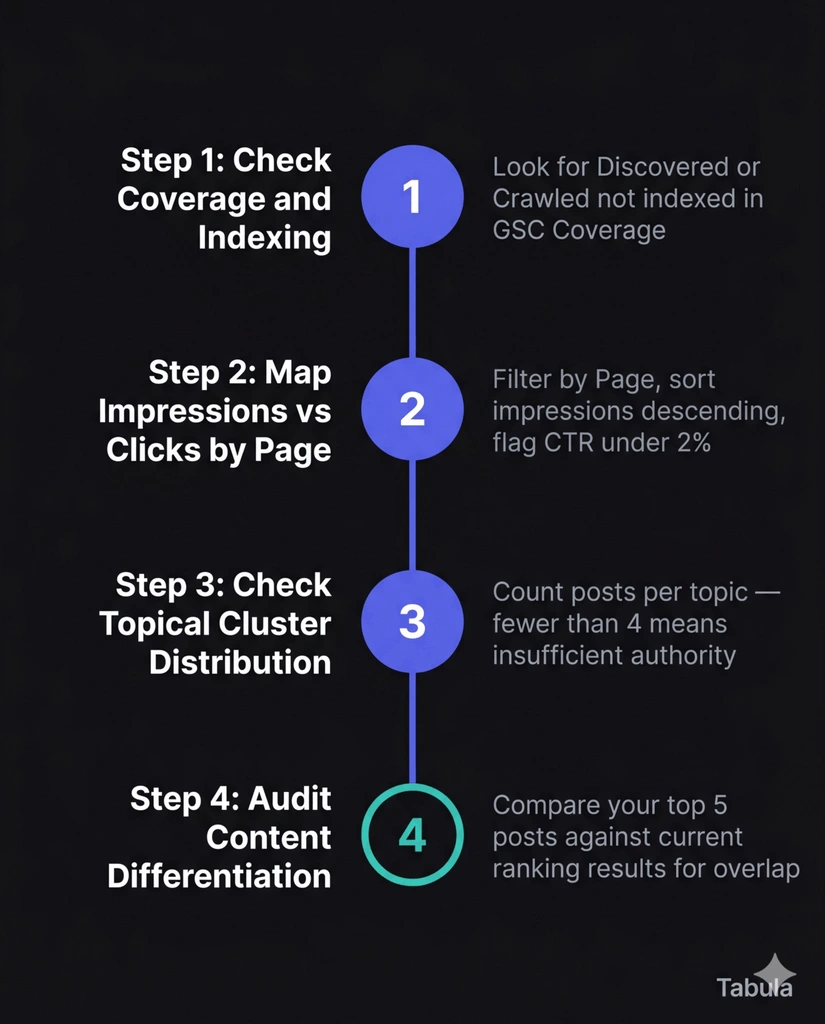
Run this four-step diagnostic against your Google Search Console data before making any content decisions.
Step 1: Check Coverage and Indexing
In GSC, navigate to Coverage (or Pages). Look for Discovered — currently not indexed or Crawled — currently not indexed statuses. If a significant share of your posts fall here, you have a crawl budget or quality threshold problem — Google is choosing not to index your content. This is diagnosis #5 (technical) or #4 (commodity content).
Step 2: Map Impressions vs. Clicks by Page
Export the Performance report filtered by Page. Sort by impressions descending. For every page with 100+ impressions and a CTR below 2%, you have a CTR problem — the post is visible but not compelling. Note the average position: anything ranked 5–20 with low CTR is a title/meta optimisation opportunity. Positions 20–50 with low impressions is a keyword competitiveness problem.
Step 3: Check Topical Cluster Distribution
List every post on your blog and tag it with its primary topic. Count how many posts belong to each topic cluster. If you have fewer than 4 posts on any topic you want to rank for, your topical authority on that subject is insufficient. Google rewards depth of coverage — breadth without depth does not build authority.
Step 4: Audit Content Differentiation
For your 5 highest-impression posts, search the target keyword in an incognito window and read the top 3 results. List every major point your post makes. Cross-reference with the ranking results. If your post shares more than 70% of its main points with existing results and adds no unique framework, data, or structural element, it is commodity content and will not outrank the established pages.
Run a full audit first: Tabula’s Professional SEO Services
The Systems Fix: What to Build Instead of Just Publishing More
Publishing more posts into a broken structure produces more invisible content. The fix is architectural, not volumetric. Here is what a functional SMB content system looks like:
Build a Pillar-Cluster Architecture First
Define your 3–5 core topics. Write one comprehensive pillar post for each — 2,000–3,500 words covering the topic definitively, with clear H2 structure, FAQ blocks, and internal links to related posts. Then build 4–8 supporting cluster posts that go deep on specific subtopics, each linking back to the pillar. This gives Google a coherent topical map and assigns your pillar post the internal link authority it needs to rank.
Match Keyword Difficulty to Your Domain Authority
Use Semrush or Ahrefs keyword difficulty scores and target only keywords with KD below 30 until your domain authority reaches at least 20–25. Use long-tail, high-specificity queries: “how to reduce marketing spend for a 10-person business; will outperform marketing tips for small business for a new domain because competition is lower and intent alignment is higher.
See how AI tools affect this: ChatGPT vs Gemini vs Copilot for Small Business Marketing
Optimise Titles and Metas for CTR at Your Ranking Position
For every post with impressions but low CTR, rewrite the title and meta description. Use the GSC average position to understand what you are competing against — search the keyword at that position and identify what the competing titles offer that yours does not. Effective titles in 2026 include: a specific quantified promise, a named timeframe, or a contrarian framing. Meta descriptions should state the specific outcome the reader gets from clicking — not a summary of the post.
Structure Every Post for AI Citation
Every post should open with a clear 2–3 sentence definitional statement of the topic. Include at least one named framework or methodology. Add a FAQ section of 5–8 questions at the end. Use H2/H3 headers that mirror the exact question format of search queries. These structural elements signal to AI crawlers that the content is extractable and citable — which drives discoverability beyond Google.
NLP and AI discoverability: What Are NLP Keywords?
The Tabula Content Diagnostic Framework
At Tabula, we apply a four-stage content diagnostic to every SMB blog we work with. The framework maps the failure state to the system fix:
| Stage | Symptom | Root Cause | System Fix |
| Index failure | 0 impressions in GSC | Crawl/indexing barrier or thin content | Technical audit + content consolidation |
| Visibility failure | Impressions rank 30–80, near-zero clicks | Keyword difficulty mismatch | Rebuild keyword strategy to KD < 30 |
| CTR failure | Impressions at position 5–20, CTR < 2% | Weak title/meta vs competitors at same rank | Title rewrite + meta optimisation sprint |
| Authority failure | Traffic plateaued, no ranking gains | No topical cluster depth, commodity content | Pillar-cluster build + proprietary content layer |
What This Looks Like for a Post-Migration Domain
For businesses that have recently migrated domains, the diagnostic applies with extra weight on the technical and authority layers. A domain migration resets the trust signals Google has accumulated — meaning even high-quality content will underperform for 3–6 months while Google reprocesses the new domain.
The priority actions for a migrated domain are:
- Verify GSC Change of Address has been submitted and processed
- Confirm all 301 redirects resolve in a single hop redirect chains add crawl cost and dilute link equity
- Rebuild topical cluster architecture from scratch on the new domain do not replicate the old site structure if it was not performing
- Begin with 3–5 low-competition keywords that can generate first-page rankings within 60–90 days early ranking signals help Google re-establish trust in the new domain
- Prioritize internal linking from day one every new post should connect to at least two existing posts
Technical reference: How AI Is Changing SEO · AI SEO Techniques to Boost Traffic
The Difference Between a Blog and a Content System
A blog is a publishing channel. A content system is an architecture that builds compounding organic authority over time where every new post strengthens existing rankings, every internal link transfers authority deliberately, and content is structured to be cited by both Google and AI tools.
The SMBs that break out of the traffic plateau in 2026 are not publishing more they are publishing within a system that makes every piece of content work harder than the last. That system has four components:
- A keyword strategy matched to current domain authority
- A pillar-cluster architecture that builds topical depth
- A content differentiation standard that requires at least one proprietary element per post
- A structural template optimised for AI citation alongside Google ranking
Without all four, publishing volume produces diminishing returns. With all four, even a new or migrated domain can build meaningful organic presence within 6–12 months.
See how Tabula builds this: About Tabula · Tabula Services
Not sure which failure state applies to your blog?
Tabula offers a free AI Marketing Audit that diagnoses your current blog and content performance — and maps the system fix to your specific situation. No pitch. Just diagnosis.
Frequently Asked Questions
How long does it take for a new blog post to rank on Google?
For established domains (Authority Score 20+), well-optimised posts on low-competition keywords (KD < 30) can reach page one within 4–12 weeks. For new or migrated domains with low authority, the realistic timeframe is 3–6 months for first-page results on long-tail queries, and 6–12 months for more competitive terms. Publishing within a pillar-cluster structure significantly accelerates this timeline by building topical authority signals faster.
Why do my blog posts get impressions but no clicks?
High impressions with near-zero clicks is a CTR failure. Your post is ranking — typically between positions 6 and 20 — but the title and meta description are not compelling enough relative to the results above and below you. The fix is to rewrite your title to be more specific, include a quantified outcome or timeframe, and ensure your meta description clearly states what the reader gets from clicking. A/B testing titles via GSC performance data can confirm which version improves CTR.
Does domain migration permanently damage SEO performance?
No — but it causes a temporary performance dip that typically lasts 3–6 months while Google re-crawls and reassigns trust to the new domain. The damage is minimised by: implementing 301 redirects on every URL (no redirect chains), submitting a Change of Address in Google Search Console, maintaining content quality and publishing cadence on the new domain, and actively building internal links within the new site structure from launch.
What is AI Overview cannibalisation and how does it affect SMB blogs?
AI Overview cannibalisation occurs when Google generates an AI-powered answer at the top of a search results page that answers the user’s query directly — reducing the need to click through to any organic result. For SMB blogs, this most commonly affects informational content: “what is”, how to, and why” queries. The mitigation is to structure content as a cited source rather than a competing answer — using clear entity signals, named frameworks, and structured FAQ blocks that AI Overview draws from rather than replaces.
How many blog posts do I need before I see traffic results?
Volume is less important than architecture. 8 posts built within a coherent pillar-cluster structure on a focused topic will outperform 40 posts spread across unrelated subjects. The minimum viable content cluster for meaningful topical authority is typically 1 pillar post plus 4–6 supporting cluster posts. Traffic results become visible when at least one cluster reaches this threshold and internal linking is in place.
Should I delete blog posts that get no traffic?
Not automatically. First diagnose why they get no traffic. Posts with zero impressions may have indexing issues or target keywords your domain cannot compete for yet consider noindexing or consolidating them rather than deleting. Posts with impressions but low clicks need title and meta optimisation before deletion is considered. Posts with traffic but high bounce rate and no conversions may need content quality improvements. Deletion should be a last resort, after consolidation and optimisation have been tested.
How is GEO different from SEO for SMB content?
SEO (Search Engine Optimisation) targets Google’s ranking algorithm focusing on keyword relevance, backlinks, technical health, and user signals. GEO (Generative Engine Optimisation) targets AI answer engines focusing on content structure, entity clarity, named frameworks, and citation-worthiness. In 2026, effective SMB content must serve both simultaneously: structured for AI extraction while optimised for Google ranking. The good news is that GEO best practices clear definitions, structured lists, FAQ blocks, named methodologies also improve Google rankings, so the two approaches are largely complementary.
The Key Insight
SMB blogs get no traffic in 2026 for six specific, diagnosable reasons and more content is not the answer to any of them. The fix is architectural: identify which failure state applies, build a pillar-cluster structure matched to your domain authority, add a proprietary content element to every post, and optimise for AI citation alongside Google ranking. For migrated domains, this foundation must be laid before publishing volume scales.
For a complete walkthrough of the system that produces compounding organic growth for SMBs, start with Tabula’s Professional SEO Services or contact us for a free audit.

Author
Carlos Rios
Carlos Rios is the Founder of Tabula. Before starting the agency, he spent his career inside companies — reporting to leaders who had no patience for vanity metrics and wanted straight answers about what was working and why. He built Tabula around that same standard: a marketing system the client owns, powered by AI and led by experts who explain the plan in plain language. Carlos studied philosophy for six years at York University and holds a Master's in Marketing from the Schulich School of Business.