What are NLP Keywords? (And Why Are They Key to Ranking in 2026)

If you’ve ever published a keyword-optimised blog post and still watched it sit on page three, NLP keywords are likely the missing piece. Most marketers know they need to include keywords in their content. Far fewer understand that modern search engines led by Google no longer just match words. They understand meaning.
At Tabula, we help SMBs build AI-powered content strategies that work with Google’s natural language processing systems, not against them. This guide explains exactly what NLP keywords are, how Google uses them to rank content, and how your small business can put them to work today.
What are NLP keywords?
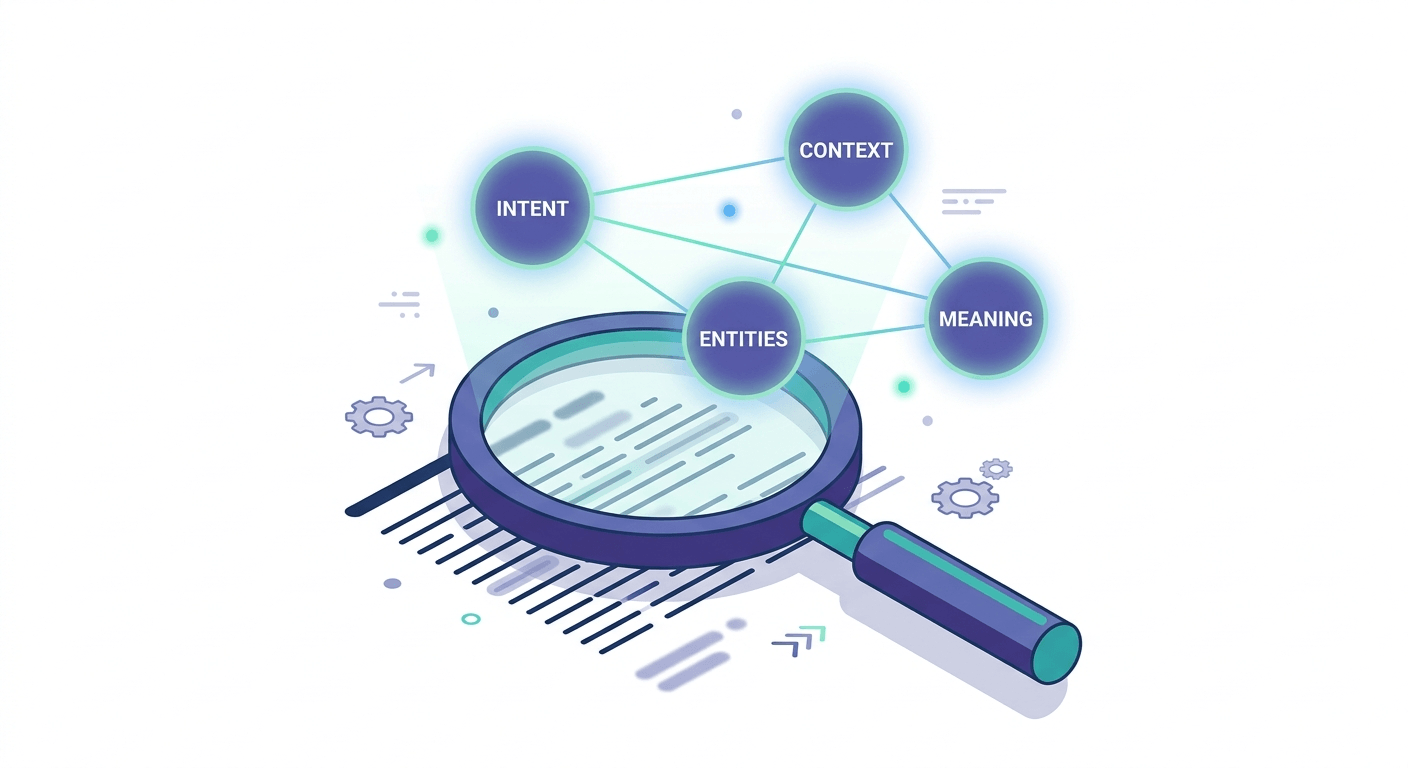
NLP keywords are words and phrases that help search engines understand the meaning, context, and intent of your content not just the literal words on the page.
Natural Language Processing (NLP) is a branch of artificial intelligence that allows computers to interpret human language the way a person would. In the context of SEO, NLP is the technology Google uses to move beyond simple keyword matching and truly understand what a piece of content is about — and whether it genuinely answers what a searcher is looking for.
Traditional SEO keywords were about exact matches. If someone searched “best running shoes,” you needed that exact phrase in your content, ideally multiple times. NLP changes that entirely. Google can now understand that “top trainers for jogging,” “best footwear for runners,” and “recommended shoes for marathon training” all mean essentially the same thing — and it ranks content accordingly.
For small business marketers, this means the game has shifted from stuffing keywords to creating genuinely helpful, semantically rich content.
NLP keywords vs. Traditional Keywords: What’s the Difference?
Understanding the distinction between traditional keyword thinking and NLP keyword thinking is essential before you change anything in your content strategy.
| Traditional keyword approach | NLP keyword approach |
|---|---|
| Match exact search phrases | Match meaning and intent behind queries |
| Repeat target keyword 10–15x | Use natural language with semantic variations |
| Focus on keyword density | Focus on topical completeness |
| Optimise for one keyword per page | Optimise for a topic cluster of related terms |
| Ignore synonyms and related concepts | Actively include entities, synonyms, and co-occurring terms |
| Write for keyword crawlers | Write for human readers (Google’s NLP models the same) |
The shift happened gradually through a series of Google algorithm updates — most notably Hummingbird in 2013, RankBrain in 2015, and BERT in 2019. Each update gave Google a more human-like understanding of language. Today, Google’s Gemini language model means search intent analysis is more sophisticated than ever.
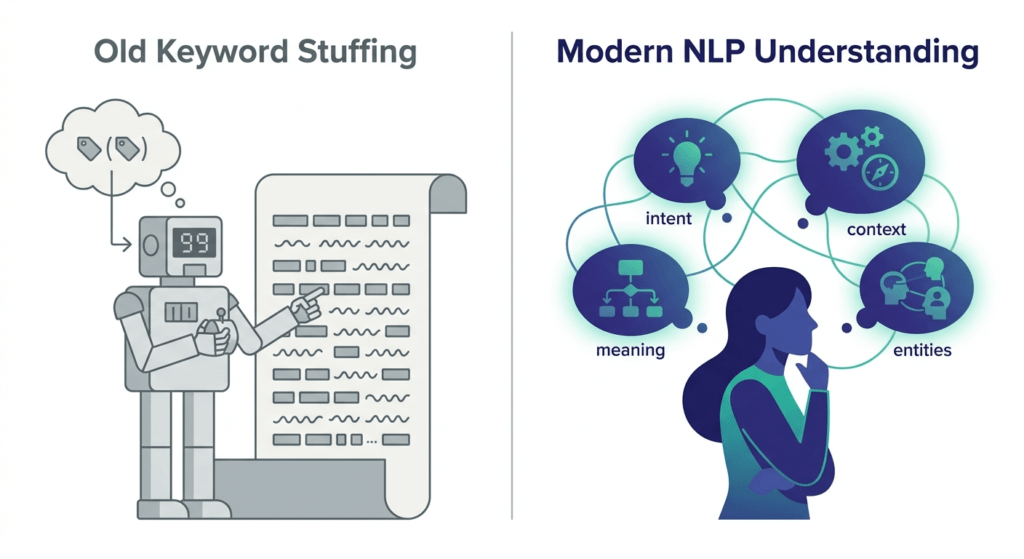
The practical implication: content that reads naturally, covers a topic comprehensively, and addresses genuine user questions will outrank thin content that simply repeats a keyword — every time.
How Google uses NLP to understand your content (BERT, entities, and intent)
To use NLP keywords effectively, it helps to understand the three core mechanisms Google uses to read your content.
BERT and transformer models
BERT (Bidirectional Encoder Representations from Transformers) was a landmark update that allowed Google to understand words in the context of the full sentence around them — not just in isolation. Before BERT, Google might interpret “Can you get medicine without a prescription?” by focusing on “medicine” and “prescription” separately. After BERT, it understood the full conversational intent: the user wants to know about over-the-counter medication options.
For your content, BERT means sentence construction matters. Writing in clear, natural language that answers questions directly performs significantly better than awkward, keyword-stuffed phrasing.
Entities
Entities are the specific people, places, organisations, concepts, and things that Google’s Knowledge Graph has indexed and understands. When you write about “digital marketing,” Google’s NLP identifies related entities: social media marketing, SEO, content marketing, paid advertising, and conversion rate optimisation among many others.
Including the right entities in your content signals to Google that your page provides comprehensive coverage of the topic. Missing key entities is one of the most common reasons well-written content still underperforms in search.
Search intent
Search intent is the underlying goal of a query. Google classifies most searches into four intent types: informational (learning something), navigational (finding a specific site), commercial (researching before buying), and transactional (ready to buy or act).
NLP keywords are closely tied to intent. A page optimised only for the keyword “marketing agency” without understanding whether the searcher wants to find one, learn about them, or compare options will struggle to rank for any version of that query consistently.
The 4 types of NLP keywords every SMB marketer needs to know
At Tabula, we use what we call the Tabula NLP Keyword Framework — four categories of keywords that, used together, give your content the semantic depth Google’s NLP models reward.
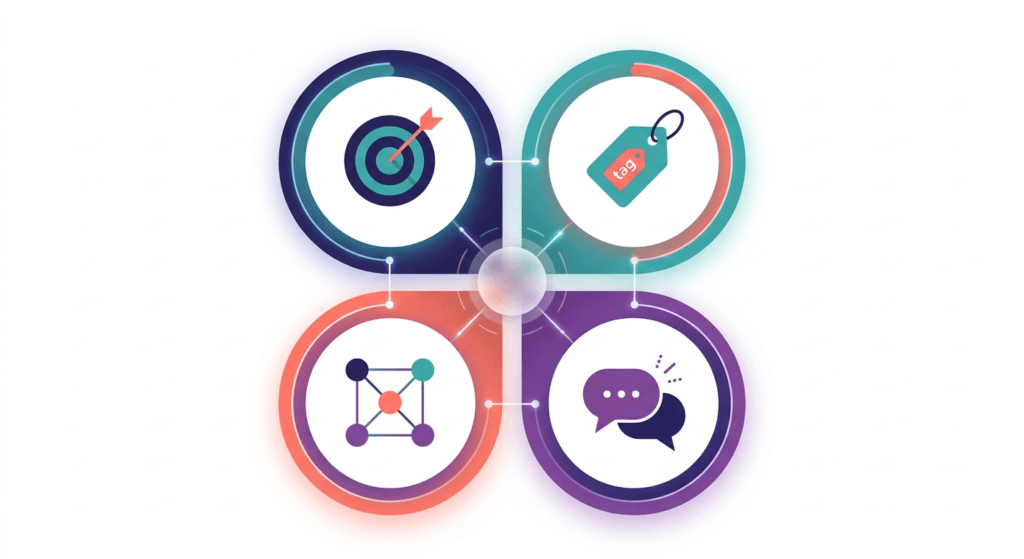
1. Intent keywords
These are the primary keywords that signal what a searcher wants to accomplish. They map directly to the four intent types above. For a local accountant, intent keywords might include “how to file taxes as a freelancer” (informational), “accountant near me” (navigational/local), or “small business accountant prices” (commercial).
Identifying the dominant intent behind your target keyword should be the first step of any content brief.
2. Entity keywords
Entities are the people, brands, tools, concepts, and places that Google expects to see mentioned alongside your main topic. Writing about email marketing without mentioning Mailchimp, open rates, subject lines, or segmentation leaves Google uncertain about whether your content genuinely covers the topic.
A practical way to find entity keywords: search your target keyword on Google and read the “People also ask” section and the related searches at the bottom of the page. These reveal the entities and sub-topics Google associates with your main topic.
3. Semantic/contextual keywords
These are synonyms, variations, and conceptually related phrases that demonstrate depth of coverage. If your main keyword is “content marketing strategy,” semantic keywords include “editorial calendar,” “content distribution,” “audience targeting,” “content repurposing,” and “content ROI.”
Including these naturally throughout your content tells Google’s NLP that your page covers the full semantic landscape of the topic — not just the surface level.
4. Conversational and voice keywords
With the rise of voice search and AI-powered assistants, more queries are phrased in full sentences: “What’s the best way to get more website traffic for a small business?” rather than just “website traffic tips.”
These conversational keywords are NLP-native — they mirror exactly the kind of natural language Google’s models are built to understand. Including question-phrased headers (H2s and H3s) throughout your content is one of the most effective ways to capture this intent.
How to find and use NLP keywords in your content (step-by-step)
You don’t need expensive tools to get started with NLP keyword research. Here’s a practical process any SMB can follow.
Step 1: Start with your core topic keyword. Enter your primary keyword into Google and look at the full SERP — not just the top results. The autocomplete suggestions, People Also Ask boxes, and related searches section all reveal the semantic field Google associates with your topic.
Step 2: Mine the People Also Ask section. Every question in the PAA box is a potential H2 or H3 for your content — and a potential FAQ question for your structured data. These are queries Google has explicitly identified as related to your main topic.
Step 3: Analyse the top 3 ranking pages. Open the top three results and scan their H2 structure. What sub-topics do they cover that you haven’t? What entities do they mention repeatedly? This tells you the semantic gaps in your current content.
Step 4: Use Google’s NLP API demo (free). Go to the Google Cloud Natural Language API demo (cloud.google.com/natural-language) and paste in a paragraph from your content. It will show you what entities and sentiment Google’s NLP extracts from your writing — directly indicating how Google reads your page.
Step 5: Write with topical completeness in mind. Rather than aiming to hit a keyword density target, aim to fully cover the topic. Ask yourself: “If someone reads this page, do they have everything they need to understand this subject?” If the answer is no, there are semantic gaps to fill.
Paid tools that help: Surfer SEO and Semrush’s SEO Writing Assistant both analyse your content against top-ranking pages and flag missing semantic terms. NeuronWriter is specifically built around NLP term analysis. These are useful but not essential — the free methods above get you 80% of the way there.
NLP keywords for small businesses: a practical SMB example
Theory is useful. A concrete example is better.
Imagine a local accountant in Manchester wants to rank for “tax help for freelancers.” Using traditional keyword thinking, they’d write a post that repeats “tax help for freelancers” throughout and calls it done.
Using NLP keyword thinking, they’d approach it differently:
- Intent keyword: “tax help for freelancers” — informational intent, so the content should educate, not sell
- Entity keywords: self-assessment tax return, HMRC, National Insurance, sole trader, expenses, UTR number, tax deadlines
- Semantic keywords: tax deductions, allowable expenses, income tax bands, self-employed tax, pension contributions
- Conversational keywords: “How do I file taxes as a freelancer?” “What expenses can I claim as self-employed?” “When is the self-assessment deadline?”
A post built on these four keyword types rather than just the core phrase covers the topic the way Google expects it to be covered. It addresses intent, includes the entities Google associates with the topic, uses natural semantic variations, and answers the conversational questions people actually ask.
The result is a page that ranks not just for “tax help for freelancers” but for dozens of related queries in the same semantic cluster multiplying organic traffic from a single piece of content.
How NLP keywords connect to GEO (getting found in ChatGPT and AI tools)
Here’s something most SEO guides won’t tell you: the principles behind NLP keyword optimisation are also the foundation of Generative Engine Optimisation (GEO) — the practice of getting your content cited in AI tools like ChatGPT, Perplexity, and Google’s AI Overviews.
AI language models are trained on the same principles Google’s NLP systems use. Content that is semantically rich, clearly structured, and intent-matched doesn’t just rank in traditional search — it gets cited in AI-generated answers.
Specifically, three NLP practices translate directly into AI visibility:
Clear definitional paragraphs — AI tools extract definitions from the first paragraph after a heading. The definition section of this post (“NLP keywords are words and phrases that help search engines understand the meaning, context, and intent of your content”) is written exactly to be extractable by both Google’s featured snippets and AI answer engines.
Named frameworks — AI tools cite proprietary frameworks because they provide structured, citable information. The Tabula NLP Keyword Framework above is the kind of named concept that AI engines reference when answering “how do I do NLP keyword research.”
FAQ structure — The FAQ section below is formatted specifically to be extracted by AI Overview, ChatGPT, and Gemini as direct answers to common questions.
If you want to go deeper on this, our guide to generative engine optimisation for small businesses and our post on how to get found in ChatGPT and Perplexity cover the full GEO strategy.
What NLP keywords mean for your SMB content?
NLP keywords are not a separate strategy from SEO they are modern SEO. As Google’s language models become more sophisticated with every update, the gap between keyword-stuffed content and semantically rich, intent-matched content widens.
For small businesses, the practical shift is straightforward: stop writing for keywords and start writing for topics. Cover the full semantic landscape of your subject, use natural language that mirrors how your customers actually ask questions, include the entities Google expects to see, and structure your content so both human readers and AI systems can extract clear answers from it.
The SMBs that do this consistently are the ones that compound organic traffic over time without increasing their content budget.
FAQ: NLP keywords explained
What are NLP keywords in SEO?
NLP keywords are words and phrases that help search engines understand the meaning, context, and intent behind your content — not just match exact phrases. Natural Language Processing (NLP) is the AI technology Google uses to read content the way a human would, identifying entities, sentiment, and the relationships between concepts. NLP keywords include your core keyword, semantic variations, related entities, and conversational phrases that together signal topical completeness to Google’s algorithms.
How are NLP keywords different from regular keywords?
Traditional keywords focus on exact-match phrases and keyword density. NLP keywords focus on meaning, intent, and topical coverage. A traditional approach might target the exact phrase “best project management software” and repeat it throughout a page. An NLP approach would also include related entities (Asana, Trello, task automation), semantic variations (team collaboration tools, workflow management), and intent-matched questions (how do I organise my team’s tasks?). The NLP approach ranks for far more queries from a single piece of content.
Does Google use NLP to rank content?
Yes. Google has used NLP-based algorithms since the Hummingbird update in 2013, with significant advances via RankBrain (2015), BERT (2019), and the ongoing integration of its Gemini language models. These systems allow Google to understand the meaning and intent behind both search queries and web content — not just surface-level keyword matches. Writing content that aligns with how these NLP systems interpret language is one of the most reliable ways to improve organic rankings in 2026.
How do I find NLP keywords for free?
The most effective free methods are: (1) Google’s autocomplete and related searches — these reveal the semantic field around your topic; (2) the People Also Ask section on Google SERPs — each question is an NLP-validated sub-topic; (3) Google’s Natural Language API demo at cloud.google.com/natural-language — paste your content and see exactly what entities and sentiment Google’s NLP extracts; (4) analysing the H2 structure of the top three ranking pages for your target keyword to identify semantic gaps in your own content.
What is the difference between NLP keywords and LSI keywords?
LSI (Latent Semantic Indexing) keywords are an older concept that suggested including “semantically related” terms based on co-occurrence patterns in text. Despite being widely discussed in SEO circles, Google has confirmed it does not use LSI in its ranking algorithms. NLP keywords are broader and more accurate — they encompass the full range of semantic signals Google’s modern language models use, including entities, intent classification, sentiment analysis, and contextual understanding. When people say “LSI keywords” today, they usually mean what is more accurately described as semantic or NLP keywords.
Can small businesses benefit from NLP keyword optimisation?
Absolutely — and in many ways, small businesses benefit more than large ones. Enterprise sites rank partly on domain authority and link volume. Small businesses have to compete on content quality and relevance. NLP keyword optimisation is precisely a content quality signal — it rewards pages that genuinely cover a topic well over pages that simply have more backlinks. For SMBs targeting local and niche audiences, the specificity of NLP-optimised content (using hyper-local entities, industry-specific terminology, and intent-matched language) is a direct path to outranking larger competitors on high-intent queries.
How do NLP keywords help with AI Overviews and ChatGPT answers?
AI tools like Google’s AI Overview, ChatGPT, and Perplexity are built on the same large language model principles as Google’s NLP ranking systems. Content that performs well in NLP-based search tends to get cited in AI-generated answers for the same reasons: it has clear definitional structure, covers topics comprehensively, uses natural language, and is formatted in ways that allow AI systems to extract specific answers. Adding structured data (FAQPage schema, HowTo schema), writing explicit definitions after each H2, and including named frameworks all increase the probability of your content being cited by AI tools — this practice is called Generative Engine Optimisation (GEO).
What tools does Tabula use for NLP keyword research?
At Tabula, our NLP keyword research process combines free and paid methods depending on the client’s budget and goals. For free research, we use Google’s autocomplete, People Also Ask, and the Natural Language API demo. For deeper analysis, we use Semrush for keyword clustering and intent analysis, and Surfer SEO for semantic gap analysis against top-ranking competitors. The most important step, however, is always manual: reading the top three ranking pages for a target keyword and identifying the entities, sub-topics, and questions they cover that a client’s current content doesn’t. No tool replaces that analysis.
At Tabula, we specialise in building AI-powered SEO and content systems for small businesses. If you want help implementing an NLP keyword strategy across your site, start with a free AI marketing audit — we’ll show you exactly where your biggest content opportunities are.

Author
Carlos Rios
Carlos Rios is the Founder of Tabula. Before starting the agency, he spent his career inside companies — reporting to leaders who had no patience for vanity metrics and wanted straight answers about what was working and why. He built Tabula around that same standard: a marketing system the client owns, powered by AI and led by experts who explain the plan in plain language. Carlos studied philosophy for six years at York University and holds a Master's in Marketing from the Schulich School of Business.