What Happens When You Stop Using an Agency (And How to Not Lose Everything)

Most SMBs that leave their marketing agency feel relief first. Then, about six weeks later, the questions start. Who owns the ad account? Where are the login credentials? Why is organic traffic down 18% and nobody can explain it?
The marketing handover is one of the least-discussed and most consequential transitions in a growing business. It is not a single event. It is a system failure waiting to happen — unless you build the right foundation before the last invoice is paid.
This guide maps the real handover process: what breaks, when it breaks, what a structured transition looks like, and how to build the in-house capability that means you never have to start from scratch again.
Most marketing handovers fail not because businesses are incapable, but because agencies rarely transfer systems — only deliverables. To protect your marketing momentum: audit all asset access before the engagement ends, document every active campaign and its logic, build a 30-day continuity plan, and assign internal ownership before day one of independence. The goal is not to replicate the agency. It is to own what they built.
Why Most Marketing Handovers Quietly Fail
The failure is rarely dramatic. There is no single moment. It is a slow erosion: keyword rankings slip by two positions, email open rates drift down, a paid campaign keeps running on a setting nobody understands, and the business owner assumes the market has just changed.
The real cause is almost always the same: the agency managed the marketing, but they never transferred the knowledge. What the business received was output — content, campaigns, reports. What it needed was understanding — why those campaigns worked, what signals to watch, and what to do when performance changes.
According to a 2024 HubSpot State of Marketing report, 61% of marketers say their biggest challenge is “not having enough people, budget, or time.” For SMBs inheriting a marketing system from an agency, that challenge compounds: they do not yet know what they do not know. The gaps that hurt most are invisible on day one.
What a Marketing Agency Actually Controls (That You May Not Realise)
Before you can plan a handover, you need an accurate picture of what is actually being managed on your behalf. Most SMBs underestimate the scope.
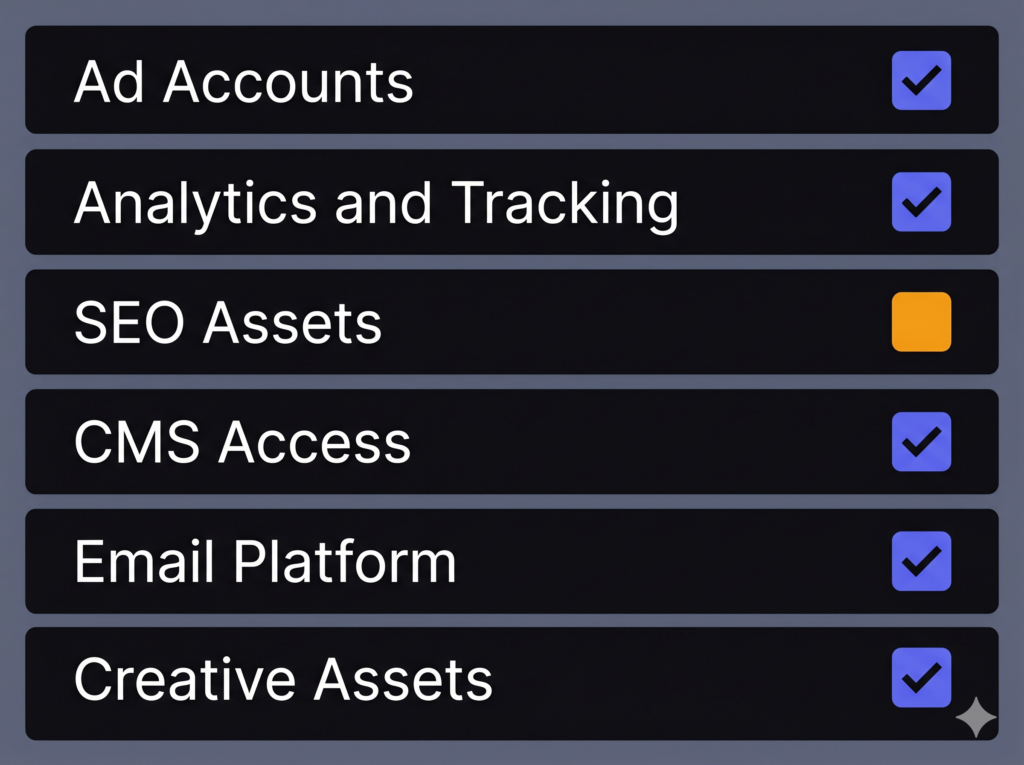
A typical agency relationship involves at least six asset categories, each of which requires a specific transfer action:
- Ad accounts (Google Ads, Meta Ads, LinkedIn): billing, ownership, campaign history, and audience data all live here. Our professional SEO services page covers what proper account ownership structure looks like when you engage an agency on the right terms.
- Analytics and tracking (GA4, Search Console, Tag Manager): these need verified ownership transfer, not just “view” access. Many SMBs discover post-handover that the agency was the primary owner.
- SEO assets (technical setup, backlink profile, keyword strategy): rankings built on an agency’s manual work are yours to maintain — but only if you know what was built and how.
- Content and CMS access: blog posts, landing pages, pillar content, and historical files should live in a system you own, not in agency shared drives.
- Email marketing platform (sequences, lists, segments, automations): this is often the most under-transferred asset, because the logic is invisible inside the tool.
- Brand and creative assets (guidelines, templates, image libraries): agencies frequently hold these in their own Figma workspaces or internal storage.
Run this audit before your notice period ends. Not after.
The Marketing Handover Checklist: What to Secure Before You Leave
The handover is not a feeling. It is a documented transfer of specific assets, access credentials, and documented logic. Every item on this list should be verified, not assumed.
Access and Ownership
- Confirm GA4 admin access under your own Google account
- Confirm Google Search Console property ownership (not delegation)
- Confirm Google Ads account ownership — not just access — with billing under your name
- Confirm Meta Business Manager ownership and all connected ad accounts, pages, and pixels
- Confirm CMS admin access (WordPress, Webflow, HubSpot, etc.)
- Confirm email platform admin access (Klaviyo, ActiveCampaign, Mailchimp, etc.)
- Confirm DNS and hosting access — particularly if the agency set up the domain or managed server configuration
Documentation
- Campaign structure and naming conventions for all active paid campaigns
- Keyword strategy: primary targets, current rankings, historical performance by page
- Email sequence logic: triggers, timing, segment rules, and the reasoning behind them
- Any active A/B tests and their current status
- Content calendar and scheduled posts
- Monthly reporting templates and the KPIs the agency tracked
Institutional Knowledge
- What was tested and what failed (this data is as valuable as what worked)
- Which audiences or segments performed best and why
- Any known technical issues or pending fixes
- Which third-party tools are being paid for and whether those subscriptions are in your name
The 30-Day Continuity Plan: Keeping Momentum Without the Agency
The most dangerous window in any marketing handover is the first 30 days. Campaigns run, emails send, content sits on the site — but without active management, each of these systems slowly drifts.
A 30-day continuity plan has one goal: nothing should break, nothing should stop, and someone in the business should understand why everything is running.
Week 1 — Stabilise
- Audit every active paid campaign. Pause anything you cannot explain. A campaign you do not understand is a liability, not an asset.
- Confirm all analytics are firing correctly. Check GA4 real-time data against known traffic sources. If it does not match, Tag Manager needs investigation before you can trust any performance data going forward.
- Identify any automated sequences running in the email platform. Document their logic before anything changes.
Week 2 — Document
- Map every page on the site receiving organic traffic above a threshold (any page with 50+ impressions in the last 90 days in GSC). These are your fragile assets. Do not change them without a plan.
- List every active tool subscription. Confirm which are in your name and which are in the agency’s.
- Create a simple performance baseline: weekly organic sessions, email open rate, ad spend, and conversion rate. You cannot know if something is broken if you do not know what normal looks like.
Week 3 — Build Internal Ownership
- Assign one person internally as the accountable owner of each system (SEO, paid, email, content). They do not need to be experts. They need to know where to look and what questions to ask.
- Set up weekly performance checks: 15 minutes per channel, looking at the same metrics each week. Consistency matters more than sophistication at this stage.
Week 4 — Assess and Plan
- Review performance against the baseline set in Week 2. Flag any channels where performance has moved by more than 10% in either direction.
- Decide which channels you will actively invest in, which you will maintain, and which you will pause. This is a strategic decision, not a default.
Why the Handover Reveals Whether You Have a System or a Supplier?
There is a useful test any SMB can apply after an agency relationship ends: if you removed every person who touched your marketing over the last 12 months, how much of the knowledge would disappear with them?
If the honest answer is “most of it,” you had a supplier. You were buying activity. If the answer is “very little, because the logic is documented and the systems are owned,” you had a partner who helped you build something.
This distinction matters because the goal of any marketing engagement should not be dependency. It should be capability transfer. The Build → Run → Train → Own model exists precisely to close this gap. Marketing independence is not a destination you arrive at by accident — it is something that has to be designed into the engagement from day one.
Most agency relationships operate on a different model, not because agencies are malicious, but because recurring retainers are the business model. Dependency is structural, not intentional. Understanding this is the first step to protecting yourself before you sign the next contract.
How to Build In-House Marketing Capability That Survives the Handover
The businesses that handle marketing handovers well share a common pattern: they started building internal capability before the agency relationship ended, not after.
Building in-house capability does not mean hiring a full marketing team. For most SMBs, it means three things:
- A documented system: every active campaign, sequence, and strategy has a written record of what it does, why it was set up, and what good performance looks like. This document lives with the business, not the agency.
- A trained internal lead: one person who understands the system well enough to manage it day-to-day, escalate the right questions, and brief any future external support accurately.
- Access to the right tools: GA4, Search Console, and the core marketing platforms all under the business’s own accounts, with login credentials in a secure internal password manager.
Google Search Console data is particularly important here. It is free, authoritative, and shows you exactly which queries are bringing people to your site, which pages are gaining or losing visibility, and where your biggest organic opportunities sit. Many SMBs finishing an agency relationship discover they have never had direct access to this data. That changes immediately.
The HubSpot 2024 Marketing Trends report found that businesses with documented marketing processes are 313% more likely to report success. Documentation is not bureaucracy. It is protection.
Common Questions About the Marketing Handover
How long does a proper marketing handover take?
A thorough handover takes a minimum of 30 days and ideally runs for 60, with a parallel period where both the agency and the internal team are managing the same channels simultaneously. The overlap allows the internal team to learn in a live environment before full responsibility transfers. Rushed handovers — typically under two weeks — are the most common cause of post-agency performance drops.
What should I do if the agency is unresponsive during the handover?
Start with the assets you can access independently: request Google Ads account ownership transfer directly from Google if the agency is unresponsive, verify Search Console ownership via DNS or HTML file, and access your GA4 property directly if you have any level of access. For assets genuinely controlled by the agency, send a formal written request noting the specific items and a deadline. If this fails, your next step is legal advice, not continued email follow-up.
How do I know if my organic rankings are at risk after the handover?
Set up a GSC performance baseline before the agency relationship ends. Track your top 20 organic landing pages by impressions weekly. A 10-15% drop in impressions over a 4-week window is a signal worth investigating. A drop in clicks alongside stable impressions usually indicates a title or meta description issue, not a ranking change. A drop in average position across your main keyword cluster suggests a technical or content issue that needs immediate audit.
What is the single most important thing to do before leaving an agency?
Confirm ownership — not just access — of your Google Ads account, GA4 property, and Search Console. These three assets contain your entire performance history, audience data, and ranking intelligence. Losing access to any of them means starting measurement from zero. Everything else can be rebuilt. Historical data cannot.
The Handover Is the Test
If your marketing system falls apart when the agency leaves, the system was never really yours. A marketing handover should not feel like starting over. It should feel like taking the wheel of something that was always supposed to be driven by you.
The businesses that navigate this transition well are the ones that treated their agency relationship as a capability-building exercise from the start: asking the right questions, owning the right assets, and investing in internal understanding alongside external execution.
If you are planning a transition and want to know exactly where your current setup stands, the Tabula Marketing System Audit looks at every layer of your marketing infrastructure and tells you what you own, what you don’t, and what needs to be secured before you make any move.

Author
Carlos Rios
Carlos Rios is the Founder of Tabula. Before starting the agency, he spent his career inside companies — reporting to leaders who had no patience for vanity metrics and wanted straight answers about what was working and why. He built Tabula around that same standard: a marketing system the client owns, powered by AI and led by experts who explain the plan in plain language. Carlos studied philosophy for six years at York University and holds a Master's in Marketing from the Schulich School of Business.