How Much Does a Small Business Website Cost in 2026? (What You Actually Get for Your Money)

Most small business owners have had this exact experience: you ask for a website quote, and one agency says $1,200, another says $12,000, and someone on Fiverr says $150. All three claim they can build you a professional website. None of them explain why the numbers are so different.
The variation is not random. Website costs for small businesses in 2026 range from $500 to $25,000 for the initial build, with ongoing monthly costs between $30 and $500 depending on hosting, maintenance, and updates. What drives that gap is not the quality of the final product in isolation — it is the type of build, the provider you choose, and the specific features your business needs. This post gives you the full breakdown so you can make a decision without guessing.
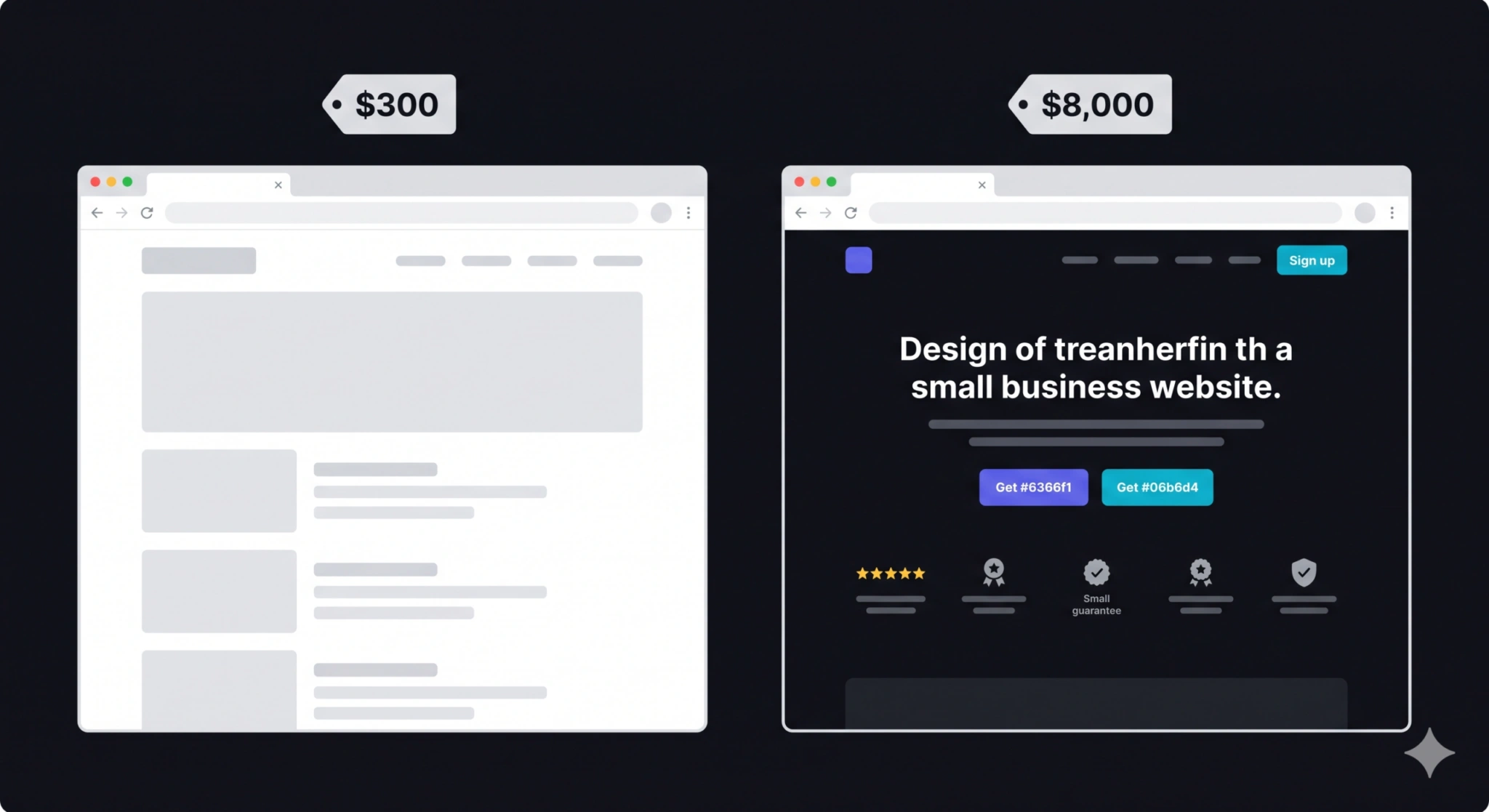
A small business website costs $500 to $2,500 on a DIY builder, $2,000 to $8,000 from a freelancer, and $5,000 to $25,000 from a professional agency. Monthly running costs add $30 to $300 for hosting and maintenance. The right budget depends on your build type, the features you need, and whether you want to own the result. Skipping investment entirely — using a free builder with a non-branded domain — costs more in credibility than it saves in cash.
What Does a Small Business Website Actually Cost in 2026?
The first thing to understand is that “website cost” has two components: the build cost (the one-time investment to create the site) and the ongoing cost (what you pay every month or year to keep it live and functional). Both matter, and most pricing conversations only address the first.
Here is where small business website costs sit across the main build types in 2026:
| Build Type | Build Cost | Monthly Cost | Best For |
| DIY Builder (Wix, Squarespace, Shopify) | $0 — $500 | $20 — $70 | Startups, solo operators, proof of concept |
| Freelancer (WordPress or custom) | $2,000 — $8,000 | $50 — $200 | Businesses needing more than a template |
| Small Agency | $5,000 — $15,000 | $100 — $300 | Growing SMBs, service businesses, lead gen sites |
| Full-Service Agency | $10,000 — $25,000+ | $200 — $500 | Established businesses, ecommerce, brand-led builds |
These ranges hold across Canada in 2026. What shifts them is what you are actually building — which is where most business owners get confused.

Why Website Quotes Vary So Much: The Three Things That Drive Price
When two agencies quote you radically different numbers for “the same” website, they are almost certainly not quoting the same thing. Three variables account for most of the gap.
1. Custom design vs. template
A template-based build — whether on a drag-and-drop builder or a WordPress theme — costs less because the design decisions are already made. A developer applies your branding to an existing structure. Custom design means a designer creates your layout, user experience, and visual language from scratch. That process takes three to six times longer, and the cost reflects it.
2. Number of pages and features
A five-page brochure site (home, about, services, blog, contact) is a fundamentally different project from a 30-page site with a client portal, online booking, and ecommerce functionality. Each feature adds scoping, development, and testing time. Most agencies price by feature set, not by page count alone — so two sites with the same number of pages can vary by thousands of dollars depending on what those pages do.
3. Who builds it
A freelancer in your city charges differently from an offshore developer, a boutique agency, or a full-service firm. The price gap is not always a quality gap — but it does affect accountability, communication, timelines, and what happens when something breaks six months post-launch. The cheapest quote is not always the lowest total cost.
What You Actually Get at Each Price Point
The number tells you what you pay. What matters is what you get for it — and where the real trade-offs are.
Under $500: DIY builders
Wix, Squarespace, and Shopify all offer functional, mobile-responsive websites for under $50 per month. You can launch in a weekend with no coding knowledge. The trade-off: you are working within the platform’s design constraints, your site lives on their infrastructure, and SEO flexibility is limited. For a business testing a concept or operating in a space where the website is a formality rather than a conversion tool, this is a rational starting point.
Where DIY breaks down: if your business competes on digital presence — service businesses, professionals, anyone generating leads online — a generic template signals to prospects that you have not invested in your own credibility. That is a cost that does not show up on an invoice.
$2,000 — $8,000: Freelancers
This range covers the majority of small business website builds done by independent web developers and designers. You get a custom or semi-custom WordPress or Webflow site, usually five to fifteen pages, with your branding applied. A good freelancer at this level will give you a site that performs technically, loads fast, and looks professional.
The honest caveat: freelancer quality varies enormously at this price range. Before hiring, ask to see three live sites they have built in the last 12 months. Test the page speed on PageSpeed Insights. Check whether the sites rank for anything. A site that looks good but loads slowly or has no SEO structure built in is an expensive starting problem.
$5,000 — $15,000: Small agencies
At this investment level, you should expect a dedicated discovery process, a defined project scope, multiple rounds of design review, structured content planning, and a build that is performance-optimised from day one. A good small agency will hand you a site with technical SEO foundations in place — clean URL structure, schema markup, sitemap, proper heading hierarchy, fast load times — not just a site that looks the part.
This is also where you start to see integration work: CRM connections, booking systems, lead capture automation. For businesses where the website is the primary customer acquisition tool, this investment typically pays back within six to twelve months of consistent traffic growth.
If your business is at a stage where the website needs to actively generate leads — not just exist — this is the range worth taking seriously. Tabula’s web development services are built for exactly this: sites that are designed to rank, convert, and perform, not just look credible.
See what a performance-built website looks like: Tabula Web Development Services
$10,000 — $25,000+: Full-service agencies
At the higher end of the small business market, you are paying for strategy, not just execution. Full-service builds include a brand audit, competitor analysis, a content strategy tied to the site architecture, SEO research built into the information architecture, and often copywriting. For businesses in competitive markets where every percentage point of conversion rate has significant revenue implications, this is not over-investment — it is precision spending.
The Ongoing Costs Most Business Owners Underestimate
The build cost is a one-time line item. The ongoing costs are what you pay forever, and they are what most businesses budget incorrectly.
Hosting and domain
A domain name costs $15 to $25 per year. Shared hosting for a small site runs $5 to $20 per month. Managed WordPress hosting — which handles updates, security, and performance automatically — costs $25 to $100 per month. For businesses where downtime has real consequences, managed hosting is not a luxury.
Maintenance and updates
A WordPress site with no maintenance plan will accumulate plugin conflicts, security vulnerabilities, and broken functionality within 12 months of launch. Most agencies offer maintenance retainers at $75 to $200 per month covering updates, backups, and minor content changes. This is often the first thing businesses cut and the most expensive thing to skip.
SEO and content
A website that no one finds is an expense, not an asset. Ongoing SEO and content investment — whether through an agency or in-house — is what converts a website from a brochure into a lead generation machine. Tabula’s SEO services are designed for small businesses that want their website to actually find new customers, not just validate existing ones.
Learn how we approach it: Professional SEO Services for Small Businesses
How to Set a Website Budget Without Getting It Wrong
The most common budgeting mistake small business owners make is starting with a number rather than starting with a goal. The right question is not “what can I afford?” — it is “what does this website need to do, and what is that outcome worth?”
A local service business generating $300,000 in annual revenue where a website redesign could convert 20% more inbound enquiries has a very different calculus than a startup pre-revenue testing a new service. The first business can justify $10,000 in a heartbeat. The second should probably start at $2,000 and rebuild in 18 months once they know what their customers actually want.
Three questions to answer before you set a number:
- What is the primary job of this website — lead generation, credibility validation, ecommerce, or a combination?
- What does a single new client worth to you in lifetime value?
- What is the real cost of staying with your current site for another 12 months?
The answers will tell you whether $3,000 or $15,000 is the rational investment — not gut feel, and not the cheapest quote.
Not sure where to start? Our team works with small businesses to scope websites that match what the business actually needs — not the most expensive option, and not a build you will outgrow in six months.
Talk to Tabula about what a website project should actually cost for your business.
Common Questions About Small Business Website Costs
What is the average cost of a small business website in Canada?
Most small business websites in Canada cost between $2,000 and $10,000 for the initial build, depending on complexity and provider. A freelancer-built WordPress site typically runs $2,000 to $6,000. A small agency build with SEO foundations and conversion-focused design runs $5,000 to $12,000. Ongoing costs add $50 to $300 per month for hosting and maintenance.
How much should a small business pay for a website?
The right amount depends on what the website needs to do. A service business that generates leads online should treat a website as a revenue tool, not an operating expense — in that context, $5,000 to $10,000 for a well-built site is a rational investment. A business where the website primarily serves as a credibility reference for warm referrals can achieve its goals for $2,000 to $4,000.
Can I build a small business website for free?
Yes — platforms like Wix, Google Sites, and WordPress.com offer free tiers. The limitation is branding (your site lives on their domain, not yours), design constraints, and credibility signals. A free Wix site with a Wix subdomain works for a side project but is a meaningful credibility cost for a business operating in a competitive market. A custom domain and paid hosting plan eliminates the most visible of these signals for under $20 per month.
How much does website maintenance cost for a small business?
Website maintenance retainers for small businesses typically run $75 to $200 per month. This covers platform and plugin updates, security patches, offsite backups, and minor content edits. Businesses on unmanaged hosting without a maintenance plan can expect to spend significantly more — in time, emergency developer fees, or both — when problems compound over 12 to 18 months.
Is a more expensive website worth it for a small business?
If your website is a passive brochure, price it accordingly. If it is your primary lead generation and conversion tool, the question is not whether a better website is worth it — it is how long until it pays back. A $10,000 website that converts 15% more enquiries for a business where a client is worth $5,000 over their lifetime pays for itself in two clients. That math is worth doing before deciding the cheaper quote is the smarter decision.
Related Resources for Small Business Owners
Building a website is one piece of a functional marketing system. These resources cover what comes next:
- How to Optimise Your Google Business Profile — read the guide
- Why Your SMB Blog Gets No Traffic — and the AI-era fix
- AI Lead Generation for Small Business — how to build a system that works
- How to Automate Your SMB Marketing in 30 Days — without hiring anyone
A small business website costs what the business needs it to cost — which is a different number for every company. What does not vary is the underlying principle: a website built without a clear job description, a defined audience, and a performance standard is money spent without a return to measure.
The businesses that get this right do not pick the cheapest quote. They pick the build that matches their current stage, with a provider who can be accountable for performance, and they treat the website as a system component rather than a one-time purchase.
If you want a straight answer on what your specific website should cost — and what it should actually do —
get in touch with the Tabula team. We scope projects for small businesses without the upsell.

Author
Carlos Rios
Carlos Rios is the Founder of Tabula. Before starting the agency, he spent his career inside companies — reporting to leaders who had no patience for vanity metrics and wanted straight answers about what was working and why. He built Tabula around that same standard: a marketing system the client owns, powered by AI and led by experts who explain the plan in plain language. Carlos studied philosophy for six years at York University and holds a Master's in Marketing from the Schulich School of Business.