

What Google Ads Management Should Include (And What You Should Own)

Your agency sends a monthly report. Impressions up, cost per click down, conversions “trending well.” Then you check the bank account and nothing has changed.
That gap between the report and the revenue is the single most common reason business owners start questioning their Google Ads management. Usually the answer isn’t that the agency is lying. It’s that nobody ever agreed what “management” was supposed to include, so the work drifted toward whatever was easiest to report on. And in most cases the owner has no way to check, because they don’t have admin access to the account being reported on.
This is what should be in scope, what shouldn’t, and the five things you need to hold in your own name before you renew anything.
Google Ads management should include account structure, keyword and negative keyword management, ad copy testing, conversion tracking, budget pacing, and reporting tied to revenue rather than clicks. Separately, you should hold admin ownership of the Google Ads account, the conversion tracking setup, the analytics property, the creative assets, and the historical data. Those five are ownership questions, not service questions.
What does Google Ads management actually include?
Google Ads management is the ongoing work of structuring, funding, testing and measuring paid search campaigns so that spend produces profitable customer acquisition. It is not the same as campaign setup, which is a one-time build, and it is not the same as reporting, which is the output rather than the work.
A scope that holds up looks roughly like this:
- Account and campaign structure. Campaigns split by intent and margin, not by whatever the account looked like at launch. Structure is the thing that determines whether budget can be controlled at all.
- Search term and negative keyword management. Reviewing what people actually typed, not what you bid on. This is where wasted spend lives, and it accumulates weekly.
- Ad copy and asset testing. Running variants with enough volume behind them to produce a real result, and retiring losers.
- Bid strategy and budget pacing. Deciding which automated bidding strategy fits the conversion volume you actually have, and adjusting when it doesn’t.
- Conversion tracking integrity. Making sure the conversions being optimised toward are real business events, deduplicated, and correctly valued.
- Reporting tied to revenue. Spend, leads, qualified leads, closed revenue. Not impressions.
- Strategic review. Someone senior asking whether paid search is still the right channel for the budget, and telling you when it isn’t.
What isn’t included, and shouldn’t be
Landing page builds, offer design, sales follow-up and creative production are usually separate lines of work. That isn’t a technicality. Paid search converts what the landing page and the offer let it convert, so an agency managing ads against a page it doesn’t control has a hard ceiling on results. If a proposal quietly folds landing page work into “management” without hours or a deliverable attached to it, that work is not happening.
The same applies to CRM hygiene. If lead quality is the problem, the fix is upstream of the ad account.
Why conversion tracking is the part that decides everything else
Conversion tracking is the mechanism that tells Google which clicks were worth buying. Get it wrong and every downstream decision, every bid, every budget shift, every “optimisation,” is optimising toward the wrong thing.
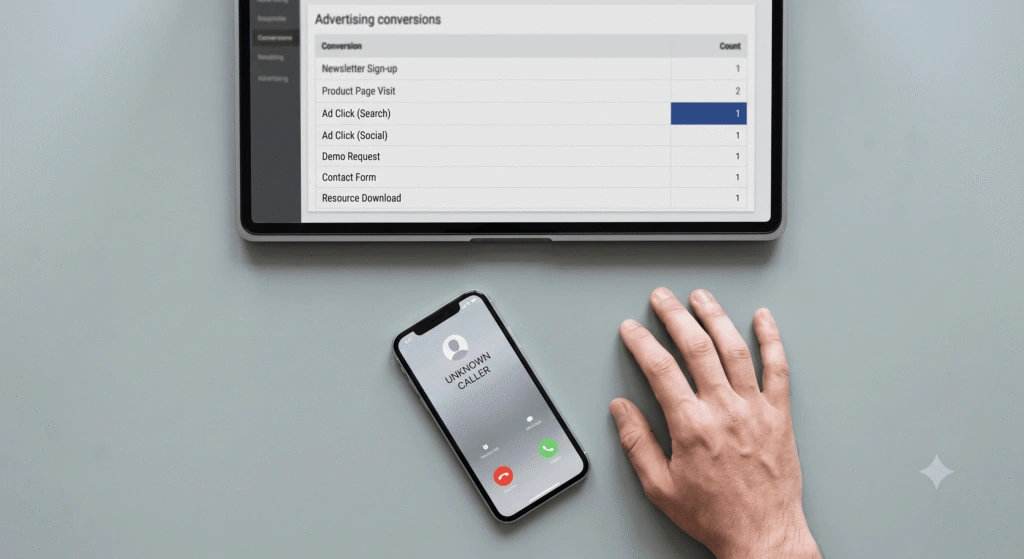
The failure mode is rarely a missing tag. It’s a tag counting the wrong event. Common versions: form views counted as submissions, so the account optimises toward people who looked at a form and left. Every phone call counted as a conversion regardless of length, so the account learns to buy wrong numbers. Thank-you page reloads counted repeatedly, so a single lead reports as four. All three produce reports that look good and revenue that doesn’t move.
If you audit one thing before renewing a management contract, audit what a “conversion” is defined as in the account. We wrote up the wider version of this in why Google Ads campaigns stop converting, because it’s almost never a bidding problem.
What should you own?
You should hold administrative ownership of the Google Ads account, the analytics property, the tag management container, the creative assets, and the account’s historical data. An agency can and should have full working access to all of it. What it shouldn’t have is the ability to walk away with any of it.
The distinction sounds pedantic until you change agencies. Then it’s the whole game. This is the principle behind the Marketing Ownership Framework: the client holds title to the system, the agency holds the responsibility for running it.
The five assets that quietly stay with the agency
This is the part that doesn’t show up in any proposal, and it’s where most owners discover the problem far too late.
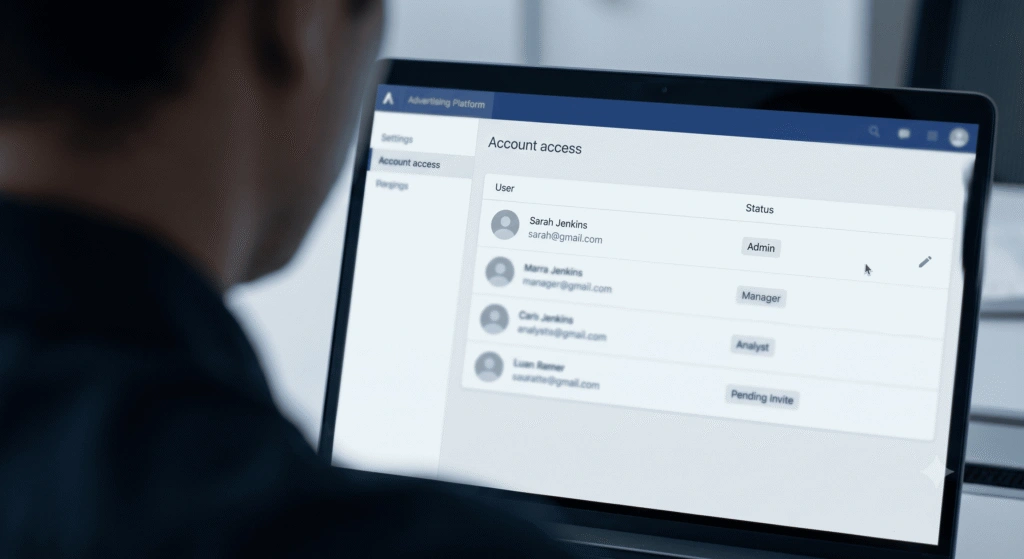
- The ad account itself. If your account sits inside the agency’s manager account and was created by them, you may be a linked user rather than the owner. Ask whose Google account holds the admin role, and check it yourself in the account’s access settings rather than taking the answer on trust.
- The conversion tracking. If tags were deployed through the agency’s own tag manager container, tracking dies the day access is revoked. The account then has no conversion signal, and every automated bid strategy running in it degrades immediately.
- The negative keyword lists. Years of search term review compressed into a shared list. If that list lives at the agency’s manager account level rather than in your account, it leaves when they do, and the wasted spend it was suppressing comes straight back.
- The creative and asset library. Ad copy variants, extensions, image and video assets, and the test history that shows which ones won. Losing the test history means the next agency reruns tests you already paid for.
- The historical data. This is the one nobody plans for. Account history is what makes automated bidding work. Rebuilding in a fresh account doesn’t just lose the reports, it resets the learning period and the performance with it.
Anyone who has actually run a handover knows which of these hurts most: the tracking. Accounts, lists and creative can be rebuilt in a week. A broken conversion signal makes the account behave badly while looking fine, and the diagnosis takes far longer than the fix.
How do you check ownership without starting a fight?
Ask for three things in writing, before renewal: the email address holding the admin role on the Google Ads account, confirmation of which tag management container the conversion tags are deployed through, and confirmation that negative keyword lists and audiences are stored at account level rather than manager level.
A partner will answer in a sentence. Reluctance is the answer. If you’re already at the point of moving, the sequence for getting everything transferred cleanly is in our guide to managing a marketing handover after leaving an agency.
What good looks like on paper
A management engagement worth renewing states the scope items above explicitly, names who holds admin access to each asset, and reports on revenue rather than platform metrics. It also tells you when paid search isn’t the right place for the next dollar. That last one is the hardest signal to fake, and the most reliable one to look for.
If you’re evaluating providers now, the questions worth asking are the same across every channel, not just paid search. We’ve listed them in what to ask before hiring a new marketing agency.
Where to go from here
Two things to do this week. Log into your Google Ads account and check the access settings to see which email holds the admin role. Then look at your conversion actions and confirm what each one counts. If either answer surprises you, the reporting problem you thought you had is an ownership problem.
Google Ads management is worth paying for. It is not worth paying for in a structure where you can’t verify the work and can’t take the asset with you. Those two conditions are separable, and the second one is entirely within your control at contract stage.
Paid search is going to get harder to audit from the outside as more of it moves behind automated bidding and asset generation. The owners who hold their own accounts will be the ones who can still tell what’s happening in them.
Find out what you actually own
We’ll audit your Google Ads account structure, tracking and access, and tell you plainly what’s working, what isn’t, and what wouldn’t transfer if you left tomorrow.

Author
Carlos Rios
Carlos Rios is the Founder of Tabula. Before starting the agency, he spent his career inside companies — reporting to leaders who had no patience for vanity metrics and wanted straight answers about what was working and why. He built Tabula around that same standard: a marketing system the client owns, powered by AI and led by experts who explain the plan in plain language. Carlos studied philosophy for six years at York University and holds a Master's in Marketing from the Schulich School of Business.