
The September 2026 Social Media Content Calendar That Sets Up Your Q4

You knew this was coming. September is here, the summer content you scheduled in June ran out, and the queue is empty. If you are reading this in the first week, you have not lost anything: Week 1 below is a reset week by design, and it is the easiest one to catch up on. If you are further in, start at the phase that matches your date and work forward.
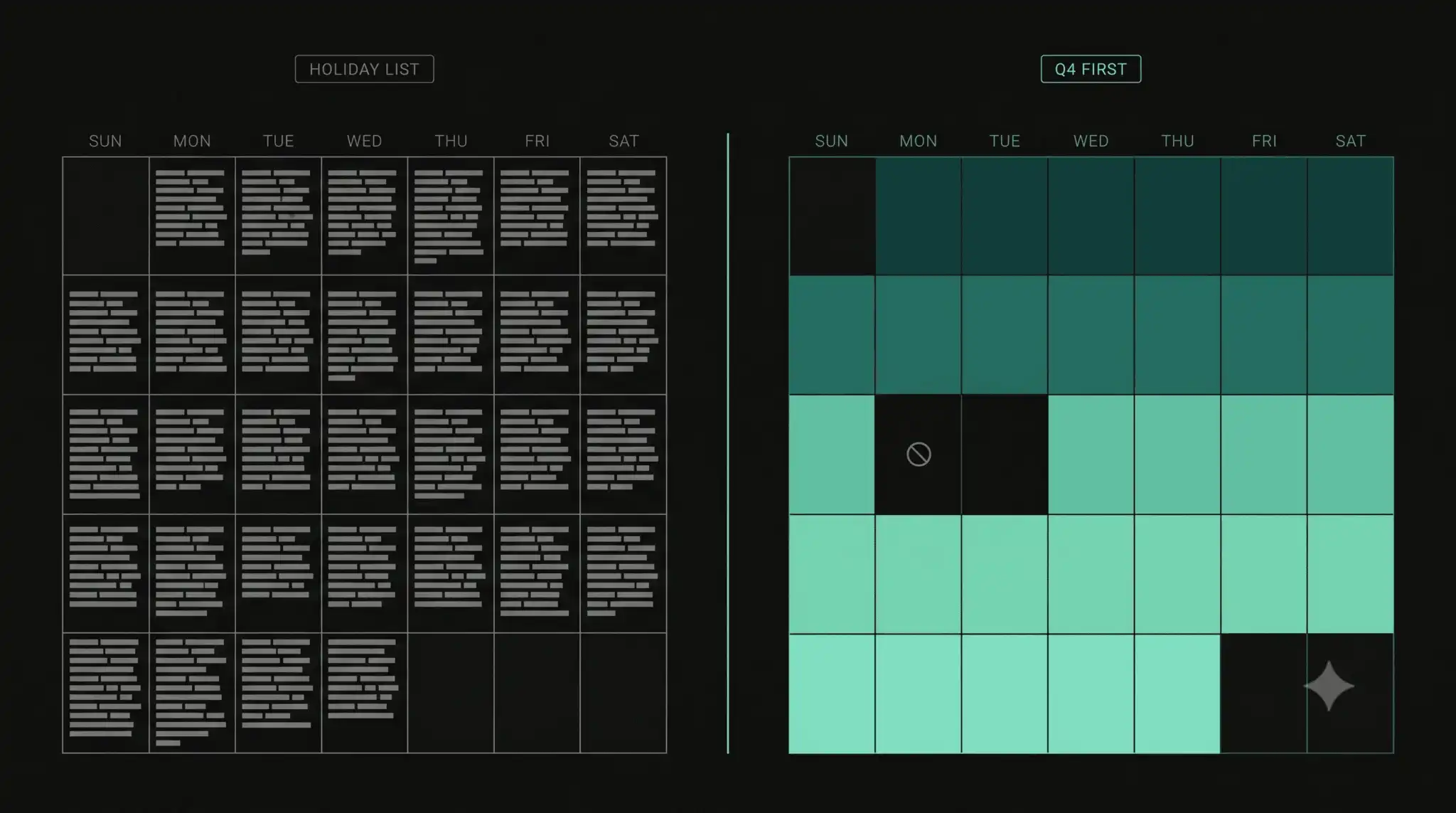
The instinct is to search for a September social media calendar, copy the holiday list, and fill the gaps. That is how most SMB social calendars get built, and it is why most of them produce engagement without producing revenue. September is not a filler month. It is the last month you can influence Q4, and a calendar built around National Coffee Day will not do that.
This is a 30-day September calendar built backwards from Q4 instead of forwards from a holiday list.
A September social media content calendar should be built around your Q4 revenue goal, not around September observances. Map the month in five phases: clear summer content, signal the season change at Labor Day, publish proof, soft launch your Q4 offer, then lock in demand. Use holidays only where they carry a real business message.
Why do most September social media calendars fail?
Most September calendars fail because they are built from observance lists that were never designed for commercial content. The calendar looks full, the posts go out, and nothing in the month moves a buying decision.
There is a straightforward way to see this. On 31 August 2026 we pulled live Semrush US data for the terms SMBs use when they plan September content. The term september awareness months returns 720 searches a month at a keyword difficulty of 25, and the results page is occupied by Lurie Children’s Hospital, Wikipedia, University College London and awarenessdays.com. Not one commercial publisher. The intent behind that query is health, education and HR reference, not marketing.
That matters because it tells you who the observance lists are actually written for. When a small business copies a September awareness calendar into its social plan, it is borrowing a structure built for a hospital’s community engagement team and using it to try to sell something in Q4. The structure is fine. The job is wrong.
The second reason is who publishes the September calendars that rank. The top of that search results page belongs to social media scheduling platforms. Their product gets more valuable the more posts you schedule, so their calendars optimise for filling 30 slots. Yours needs to optimise for a smaller number of posts that arrive in the right order.
What should a September content calendar actually be built around?
A September calendar should be built backwards from one Q4 revenue goal. Pick the outcome you need by December, then work out what a buyer has to believe in September for that outcome to be possible in November.
For most SMBs the September job is one of three things. If you sell to consumers, September is when you establish the offer that Black Friday will discount, so the offer needs to exist and be known before anyone sees a price. If you sell to businesses, September is when annual budgets get drafted and next-year vendors get shortlisted, so your job is to be on the shortlist before the conversation closes in October. If you sell a service with a delivery lead time, September is your last month of intake for anything that has to be finished this year.
Everything on the calendar then answers to that. A post either moves the buyer toward the Q4 decision or it is filler, and filler in September costs you more than filler in July because you have fewer weeks left to spend.
This is the same logic behind the Marketing Ownership Framework: the calendar is not a list an agency hands you every month, it is a system you own and can rebuild yourself next September without asking anyone.
The September 2026 calendar: 30 days mapped to Q4
September 2026 runs Tuesday 1 September to Wednesday 30 September. It contains five Tuesdays and five Wednesdays and four of every other weekday, which means if your posting cadence is Tuesday and Thursday you get five Tuesday slots and four Thursday slots. Worth knowing before you plan a symmetrical schedule that does not exist.
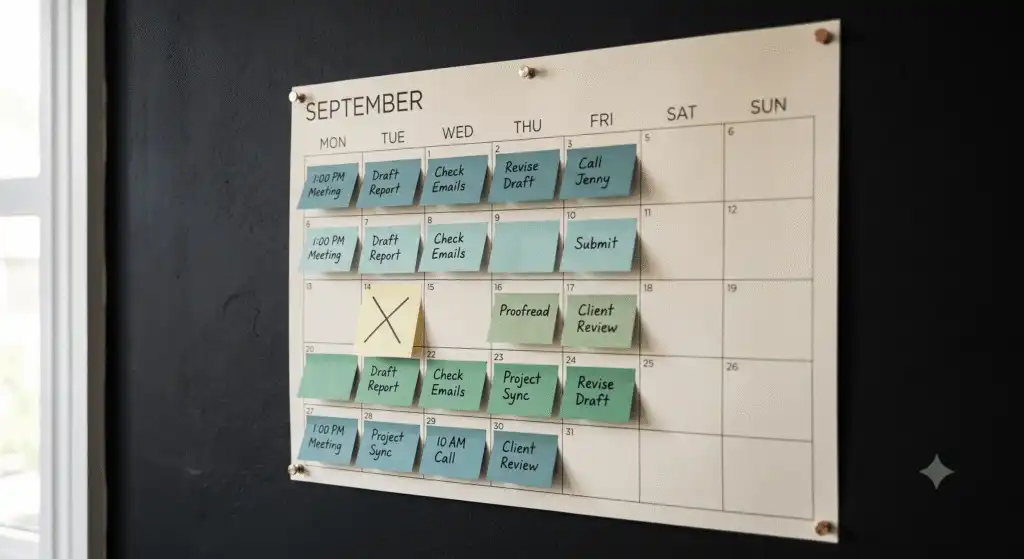
Five phases, mapped to weeks.
Week 1 (Tue 1 to Sun 6): clear the decks
Do not launch anything in the first week. Use it to close out summer and reset the account.
- Tue 1 — Month-ahead post. Tell your audience what you are working on in September. Low effort, high trust, and it commits you publicly to the plan.
- Wed 2 — Repurpose your best-performing summer post. Check your own analytics, not a trend list.
- Thu 3 — Answer the single question you were asked most over summer. Straight to camera or plain text.
- Fri 4 — Behind the scenes. What the business is actually doing this week.
- Sat 5 / Sun 6 — Nothing scheduled, or one light community post. Labor Day weekend traffic is soft in the US and Canada.
Week 2 (Mon 7 to Sun 13): the season change
- Mon 7 — Labor Day (US and Canada). Post something short and human, or say nothing. Do not run a sale post that pretends to honour labour. If you want a fuller treatment of how to handle this one, we covered it in the Labor Day marketing guide.
- Tue 8 — The first Q4 signal. Name the deadline your customers are about to run into. Not a pitch, a warning.
- Wed 9 — Educational post on the problem your Q4 offer solves. No offer mentioned.
- Thu 10 — Customer question, answered in detail. Save-worthy format.
- Fri 11 — 9/11 anniversary, and Rosh Hashanah begins at sundown.** Do not post brand content in the US market. Two observances land on the same date, so treat the whole day as scheduled silence rather than trying to acknowledge either one.
- Sat 12 / Sun 13 — Light or dark.
Week 3 (Mon 14 to Sun 20): proof
This is the week that decides whether the Q4 offer lands, and it is the week most calendars skip.
- Mon 14 — Before and after. A specific outcome with a real timeframe.
- Tue 15 — Hispanic Heritage Month begins (15 September to 15 October). Only post if you have a genuine connection to make, through your team, your customers or your community. A generic graphic reads as exactly what it is.
- Wed 16 — Process transparency. Show one part of how you work. This is the post that removes purchase anxiety.
- Thu 17 — Third-party proof. Review, testimonial, screenshot, referral.
- Fri 18 — Answer the top objection to your Q4 offer, before the offer exists.
- Sat 19 / Sun 20 — Community or off.
Week 4 (Mon 21 to Sun 27): soft launch
- Mon 21 — Waitlist, early access or “reply if you want details.” Capture intent without publishing a price.
- Tue 22 — Autumn equinox.** Season change post if it fits your brand. Skip if it does not. The equinox falls late on 22 September in North American time zones and on 23 September in UTC, so shift the slot by a day if your audience is primarily European.
- Wed 23 — Comparison content. Your approach against the obvious alternative, argued fairly.
- Thu 24 — Case detail. One customer, one problem, one result.
- Fri 25 — Direct call to action to the waitlist. First hard ask of the month.
- Sat 26 / Sun 27 — Off, or repost the week’s strongest piece.
Week 5 (Mon 28 to Wed 30): lock it
- Mon 28 — Capacity or deadline post. What runs out, and when.
- Tue 29 — National Coffee Day (US). Use it or lose it. If your business has nothing to do with coffee, the slot is better spent on a Q4 post.
- Wed 30 — Month close. What you learned, what is coming in October, what the reader should do now.
That is 22 scheduled posts across 30 days, with weekends deliberately light. Twenty-two posts you can execute beats thirty you abandon on 12 September.
Which September holidays are worth posting about?
A September holiday is worth posting about when it gives you a reason to say something you would want to say anyway. That is the whole filter.
By that test, Labor Day works because it lets you talk about how work is changing in your industry. Hispanic Heritage Month works if it connects to real people in your business. The autumn equinox works if seasonality genuinely affects what you sell. National Coffee Day works for a cafe and almost nobody else.
The ones to leave alone: any awareness day tied to serious illness, loss or crisis unless your organisation has standing in that area. September carries several, including National Suicide Prevention Month in the US and World Suicide Prevention Day on 10 September. A brand post attached to those is a reputational risk, not a content opportunity.
Verify before you publish: major religious observances move each year on the Gregorian calendar. Confirm the 2026 dates for Rosh Hashanah and Yom Kippur against a primary source before finalising the schedule, and check your own audience’s regional and national holidays. This calendar is built on the US and Canadian pattern.
How do you build this calendar so you own it next year?
Build it in a document you control, with three columns: date, post, and the Q4 goal that post serves. That third column is the entire method. If a row has an empty third column, it is filler and you can cut it without loss.
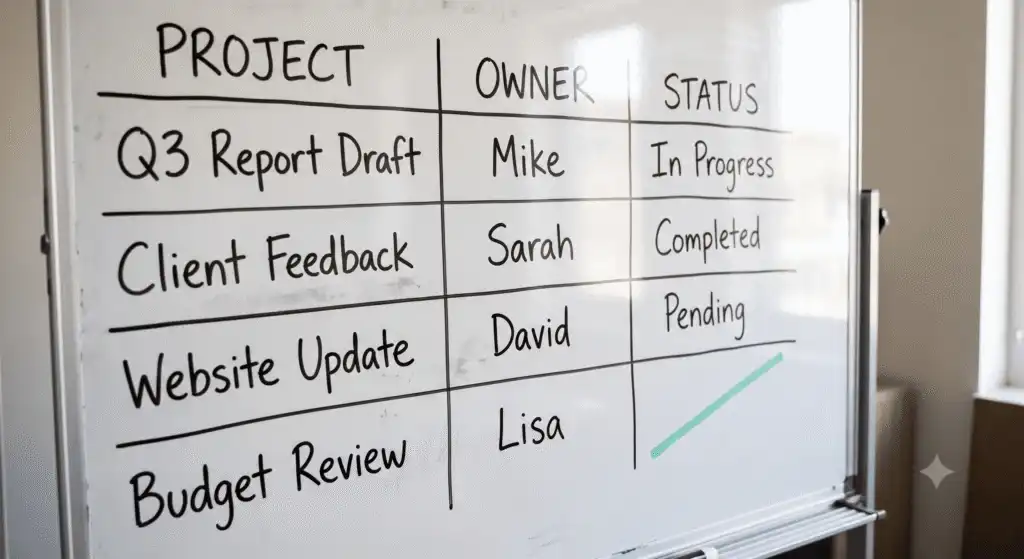
Use whatever tool you already have. A spreadsheet is fine. What matters is that the reasoning sits next to the content, because the reasoning is the reusable part. Next August you will not want last year’s post ideas. You will want to know why September was structured that way, so you can do it again with a different offer.
If you run more than one platform, decide the channel split before you write anything. September is not the month to add a platform. Our breakdown of Instagram against LinkedIn against Facebook for small business covers where each one earns its slot, and the wider view on what still works organically is in organic social media in 2026.
For the month-by-month version of this format, the August social media content calendar shows the same structure applied to a mid-summer month, where the Q4 pressure is not yet present.
What if my Q4 offer is not ready yet?
Then September’s job is to build the audience that will receive it, and the calendar barely changes.
Weeks 1 to 3 stay exactly as written, because education, proof and objection handling do not require a finished offer. Week 4 becomes audience capture rather than waitlist capture: ask people to tell you what they need for Q4 instead of asking them to join a list for something specific. You will end the month with a defined offer and the people who want it, which is a better position than a September of filler and a rushed launch in October.
The same applies if you sell to other businesses and think Q4 does not apply. It does, it just arrives earlier. B2B budget cycles mean the September conversation is about next year’s line items, so replace “Q4 offer” with “next-year shortlist” and the five phases hold.
What if you only have time for one thing this September?
Publish Week 3. Proof, process transparency and objection handling, three posts. Skip the rest of the month if you have to.
Those three posts are the ones that change whether someone buys in Q4, and they are the three that almost every September calendar leaves out in favour of holiday graphics. A month of holiday posts with no proof produces a warm audience that does not convert. Three proof posts and nothing else produces fewer impressions and more revenue.
September will not feel urgent until the second week of October, and by then the month is spent. The calendar above takes about an hour to adapt to your business, and the only genuinely difficult part is deciding what your Q4 goal actually is. Do that first. The 30 days fill themselves once the goal is fixed.
Then do the same thing in October, and again in November, and you stop needing anyone else’s calendar.
Own the calendar, not just this month
We build the social media system, run it with you, and you keep it whether you stay or not.
See how our social media services work

Author
Carlos Rios
Carlos Rios is the Founder of Tabula. Before starting the agency, he spent his career inside companies — reporting to leaders who had no patience for vanity metrics and wanted straight answers about what was working and why. He built Tabula around that same standard: a marketing system the client owns, powered by AI and led by experts who explain the plan in plain language. Carlos studied philosophy for six years at York University and holds a Master's in Marketing from the Schulich School of Business.