

Labor Day Marketing Ideas for Small Businesses: A 10-Day AI Playbook

Right now, every small business owner’s Labor Day inbox is filling up with the same email: a countdown timer, a percentage off, and a header image of a beach chair. Labor Day 2026 falls on Monday, September 7 — three weeks out from today.
Small businesses that wait until the week before end up doing exactly what the big-box retailers do, at a fraction of the ad budget, in the same crowded inbox. This playbook gives you 10 concrete days — starting August 28 — to build Labor Day marketing that looks like it came from your business, not a template, using AI to do the drafting so you’re not starting from a blank page.
Labor Day 2026 is Monday, September 7. Most small business Labor Day marketing fails because it copies the same discount-first format as national retailers with bigger budgets and more inbox real estate. This 10-day plan (Aug 28–Sept 7) uses AI for drafting and a human for judgment to build a distinct angle, a content batch, and a launch sequence — without a discount as the default move.
Why Most Small Business Labor Day Marketing Gets Ignored
Labor Day marketing content on Google right now is dominated by ecommerce platforms like Attentive and Klaviyo, whose businesses grow when their customers send more promotional email. That’s not a criticism of the tactic — it’s a structural fact worth naming.
A platform that gets paid per email sent has no reason to tell a small business owner that skipping the sale might work better for their specific brand. An independent small business doesn’t have that conflict, which means it can actually ask the harder question: does a Labor Day sale fit what my business is known for, or am I running one because everyone else is?
The volume on “labor day marketing ideas” itself is modest — real demand exists, but it’s a smaller, more specific search than the retail-heavy terms around Labor Day sales and store hours. That’s consistent with what a seasonal, non-Black-Friday holiday should produce: fewer people searching for tactics, because fewer businesses treat it as a major promotional event.
That’s an opportunity, not a weakness. Less competition for genuinely useful planning content, even at modest volume, means what does get built has a real shot at owning the space.
What Should a Small Business Actually Do for Labor Day?
Three honest options exist, and the right one depends on the business, not the calendar:
- Run a real promotion — if Labor Day already drives foot traffic or a seasonal transition (end-of-summer inventory, back-to-school overlap), a sale makes sense. Say so plainly and skip the invented urgency.
- Mark the moment without discounting — acknowledge the long weekend, thank customers, and stay visible without training people to wait for the next markdown.
- Do neither, on purpose — some businesses (professional services, most B2B) don’t have a Labor Day story worth telling. Forcing one just adds noise. See the concession section below.
The playbook that follows works for either of the first two paths. It builds the plan and the content batch; you decide which lever to pull with the promotion angle.
The 10-Day Labor Day Marketing Playbook
Ten working days, ending on Labor Day itself. Each day is intentionally small — 30 to 90 minutes — because the point is momentum, not a marketing sprint that eats your week.
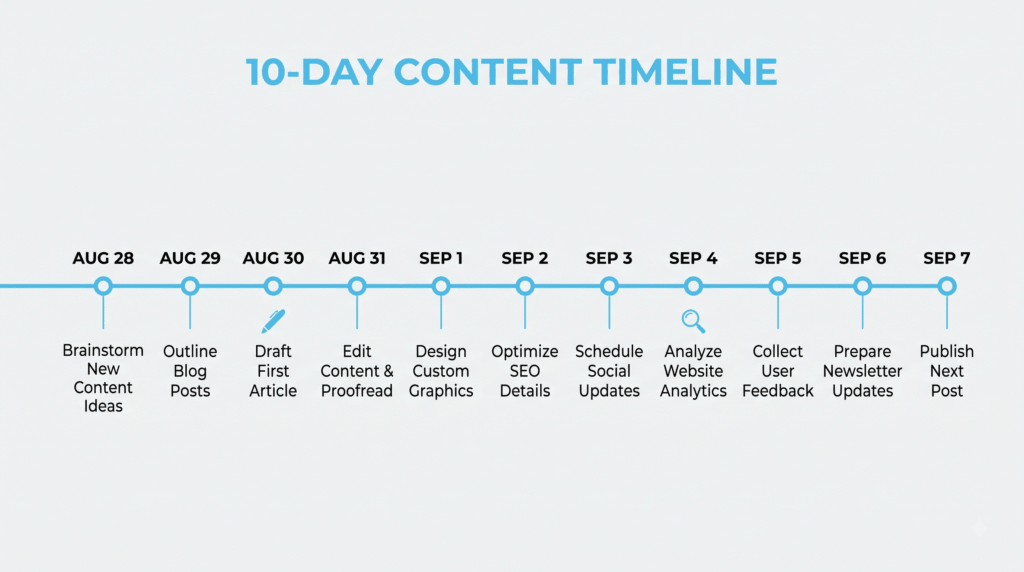
Day 1 (Aug 28) — Pick your angle, not your discount.
Before opening any tool, decide what this campaign is actually about: gratitude, a genuine end-of-summer transition, a cause you support, or a straightforward sale. Write it in one sentence. Every piece of content this week should trace back to that sentence.
Day 2 (Aug 29) — Audit what you already have.
Pull last year’s Labor Day content, your best-performing recent post, and your current photo library. You’re looking for one asset worth reusing and one gap worth filling — not starting from zero.
Day 3 (Aug 31) — Draft with AI, then edit like you mean it.
Use a chatbot to generate a first-pass caption, email subject line, and short blog blurb around your Day 1 angle. Then cut every generic line an AI defaults to — “don’t miss out,” “limited time,” “elevate your weekend.” Replace them with something only your business would say. This is the step buyers increasingly expect to see: AI drafts, a human edits and takes ownership of the final version.
Day 4 (Sept 1) — Build the content batch.
Turn the edited draft into your actual set: 2–3 social posts, one email, one short in-store or website sign if relevant. Batch it in one sitting so tone stays consistent across channels.
Day 5 (Sept 2) — Set up email and SMS.
Load the email into your platform, set the send time for the morning of Thursday, September 3 or Friday, September 4 — before the weekend gets busy — and write one short SMS if you use that channel. Don’t schedule for Labor Day itself; by then, attention is elsewhere.
Day 6 (Sept 3) — Localize for foot traffic, if it applies.
Retail and hospitality businesses should update Google Business Profile hours now — search interest in “is [business] open on Labor Day” spikes hard in the days beforehand, and a wrong or missing hours listing costs a visit you already earned.
Day 7 (Sept 4) — Schedule everything and set up tracking.
Load social posts into your scheduler, confirm the email send, and set a simple UTM or promo code so you can tell what actually worked afterward. This is the step people skip and then can’t answer “did it work?” two weeks later.
Day 8 (Sept 4) — Brief your team, even if your team is just you.
If anyone else touches customers this weekend — staff, a partner, a VA — give them the one-sentence angle from Day 1 and the promo code if there is one. A customer asking about a sale that staff haven’t heard of is the fastest way to look disorganized.
Day 9 (Sept 5) — Soft-launch and sanity check.
Read every scheduled post and email as if you were the customer receiving it, on a Saturday morning, not editing it. Fix anything that reads like it was written for a template. Confirm links and codes actually work.
Day 10 (Sept 7) — Show up live and close the loop.
Labor Day itself: respond to comments and DMs in real time if you’re running anything social, and note what you’d change for next year while it’s fresh. That single note is worth more than most of the planning that came before it.
Why Skipping the Discount Might Be the Smarter Move
It’s worth saying plainly: not discounting on Labor Day is not the safe, boring choice. Twilio’s own analysis of holiday email performance has found that subject lines without a percentage discount tend to outperform ones that lead with a number — because a discount-led subject line is competing against every other discount-led subject line in the same inbox that weekend, and a distinct one isn’t.
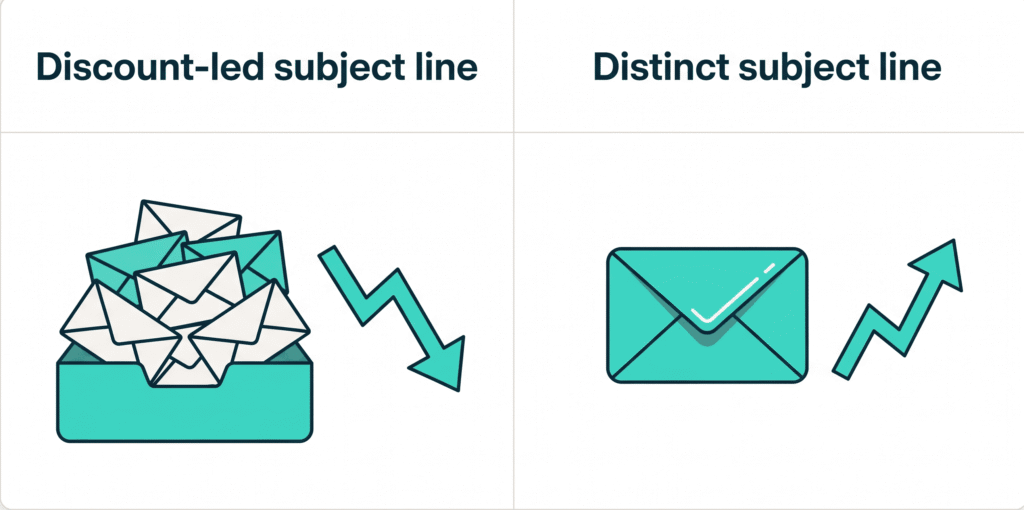
[1] Inbox volume during major promotional weekends reliably spikes — Omnisend’s 2026 data shows Black Friday and Cyber Monday email volume rising roughly 33% year over year as more brands pile on.[2] Labor Day isn’t BFCM, and the spike is smaller, but the mechanism is the same: more senders competing for the same limited attention, using the same three tactics. Standing out by not doing what everyone else is doing is a legitimate strategy, not a cop-out for businesses without a promotion to run.
What If Labor Day Isn’t Your Business’s Moment?
Here’s the honest concession: if you run a B2B, professional services, or SaaS business with no natural tie to a consumer shopping weekend, this playbook may not be worth your 10 days. Manufacturing a Labor Day angle for a business nobody associates with the holiday reads as filler, and readers notice filler faster than any algorithm does.
If that’s your situation, your time is better spent on evergreen lead generation that doesn’t depend on the calendar — B2B lead magnets built around what your buyers actually search for will do more for pipeline than a September detour ever will. If you’re not sure which category your business falls into, Tabula’s SEO and GEO services are built around exactly that kind of channel-fit question.
Where This Fits Into Your Bigger Marketing System
A 10-day sprint only pays off if it plugs into something bigger than itself. This playbook isn’t a one-off scramble — it’s a template you can run against any seasonal moment once it’s built, which is exactly the point of running your marketing as a system you own rather than a series of one-time pushes.
If you haven’t mapped that system yet, Tabula’s marketing system stack is the starting framework, and this Labor Day playbook is one plug-in inside it. For the AI drafting step in Day 3, comparing ChatGPT, Gemini, and Copilot for small business marketing will help you pick the right tool before you’re mid-sprint, and if you’d rather have a competitor’s content gaps mapped out before you write anything, the AI competitor analysis tool does that in a few minutes. And if you want the next seasonal moment already planned before it sneaks up on you, August’s social content calendar and the Memorial Day AI playbook cover the two other ends of the summer.
The takeaway that matters most: the businesses that get remembered over Labor Day weekend aren’t the ones with the deepest discount. They’re the ones that sounded like themselves in a weekend where everyone else sounded the same. Pick your angle on Day 1, let AI handle the first draft, and spend your actual judgment on the edit — that’s the whole playbook. Start August 28, and you’ll be done well before the long weekend starts.

Author
Carlos Rios
Carlos Rios is the Founder of Tabula. Before starting the agency, he spent his career inside companies — reporting to leaders who had no patience for vanity metrics and wanted straight answers about what was working and why. He built Tabula around that same standard: a marketing system the client owns, powered by AI and led by experts who explain the plan in plain language. Carlos studied philosophy for six years at York University and holds a Master's in Marketing from the Schulich School of Business.