

Back to School Marketing for Local Businesses

Most local business owners treat going back to school as an August job. They block off the last week of July to build the promotion, push everything live in the first days of August, and then wait for foot traffic that never quite matches the effort. The problem is rarely the campaign. The problem is the calendar it runs on.
By early July 2025, 67 percent of back-to-school shoppers had already started buying, up from 55 percent a year earlier and the highest figure since the National Retail Federation began tracking early shopping in 2018. A business that only switches its marketing on in August is not arriving early for the season.
It is arriving after two thirds of the demand has begun forming, at the exact moment its advertising is least able to perform. This guide covers what to set up in July so your marketing is warmed up and working before the spike, rather than scrambling to catch it.
A quick mid-year marketing review in early July is the natural trigger, because it lands right before the season your revenue depends on.
Back-to-school demand for local businesses forms in July, not August. Two thirds of shoppers start by early July, yet most still have the majority of their spending left. Setting up in July lets your Google Ads clear the learning phase, your Google Business Profile re-index, and your reviews and social build before demand peaks. An August start spends the peak stuck warming up.
When does back-to-school shopping actually start?
Back-to-school shopping now begins in early summer, with the heaviest activity landing in July. The NRF’s 2025 survey found 26 percent of families had started by early June and 67 percent by early July, the earliest pace on record.
Starting is not the same as finishing, and that gap is the whole opportunity. In the same survey, 84 percent of shoppers still had at least half of their purchases left to make, with many waiting for the best deals or still deciding what they needed.
So by July the local customer is already in the market, still has most of their money unspent, and is actively comparing where to spend it. The question is not whether to show up. It is whether your marketing can perform the moment they start looking.
Why is August too late for back to school marketing?
August is too late because the systems that drive local visibility need time to warm up, and that warm-up runs on the platform’s schedule, not yours. Launch a new Google Ads campaign in August and it enters a learning phase before it performs.
Google’s automated bidding needs roughly 50 conversions and, by Google’s own documentation, up to about three weeks or one to two conversion cycles to calibrate to a new campaign. A high-volume advertiser can clear that in under a week.
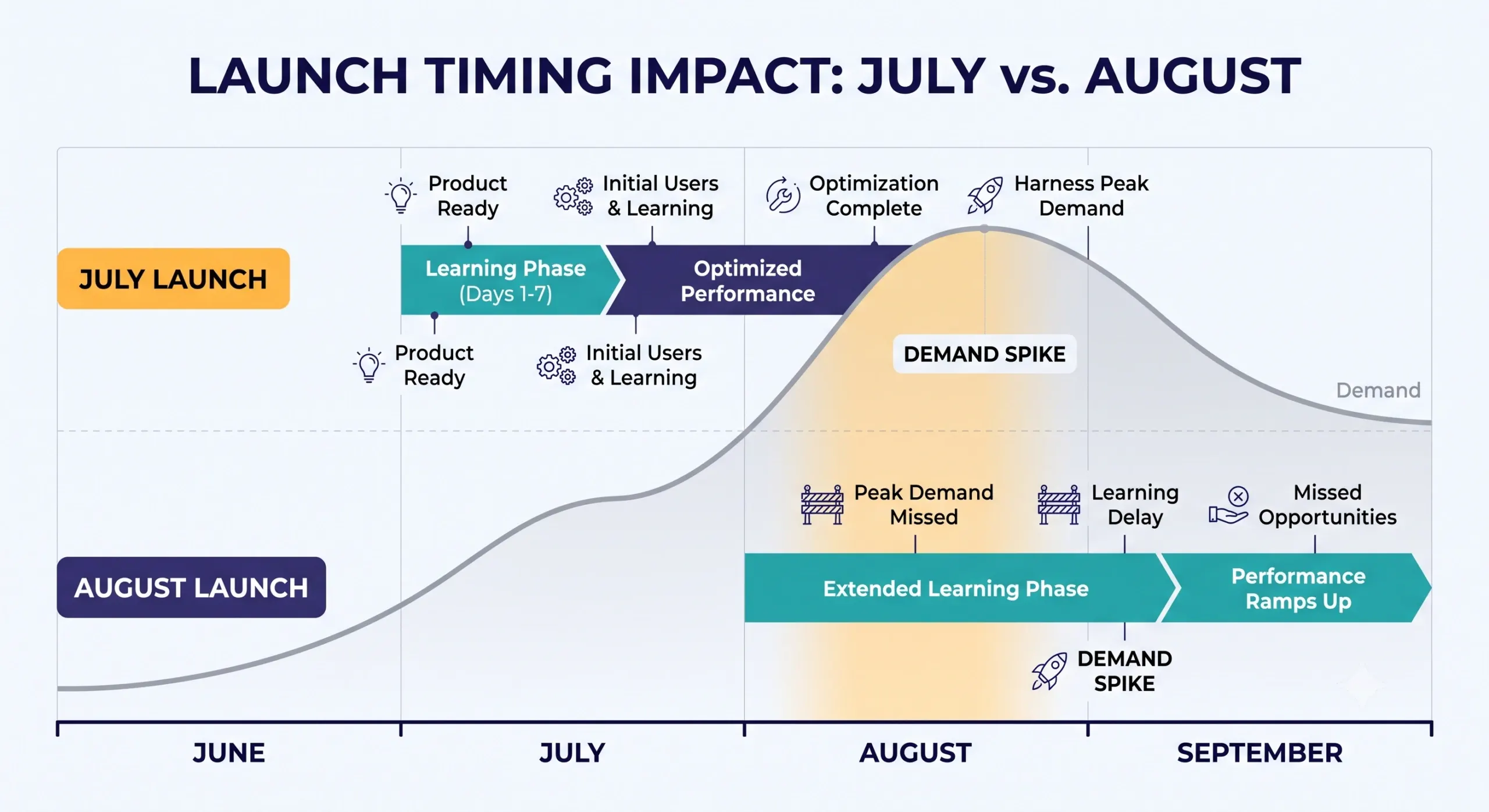
A typical local business generating a handful of conversions a week cannot: its learning phase can stretch across the entire back-to-school window, or stall in a “Learning Limited” state that never fully optimises.
A campaign launched in the first week of August therefore spends the peak demand weeks in its least efficient, most volatile state, paying more per result while competitors who launched in July run on calibrated bids.
The same lag applies away from the ad account. Edits to a Google Business Profile, new categories, updated hours, fresh photos and posts, take time to surface, and new customer reviews arrive on their own timeline rather than on demand. Organic search and email compound over weeks; they do not switch on. None of these systems rewards a standing start.
Not sure how warmed up your local presence actually is right now? That is exactly what a pre-season SEO and local audit is for: it tells you what will and will not be ready before demand arrives.
This is the point worth sitting with: the real back-to-school deadline is not the first day of term. It is the moment your systems need to already be live, calibrated and earning trust.
What is the Pre-Spike Window?
The Pre-Spike Window is the stretch of time before a seasonal demand peak during which your marketing must be set up, launched and calibrated in order to perform at the peak itself. For back to school, that window is July. Miss it and you are not late by a few days. You are late by one full learning phase and one review cycle.
Tabula calls the readiness check that runs inside this window the Pre-Spike Audit: a short, repeatable review of the five systems that carry a local business through any seasonal peak, run while there is still time to fix what it finds.
The value is not the checklist. It is the timing. The same five checks run in August are a post-mortem. Run in July, they are a head start.
What should a local business set up in July?
Set up the five systems below in July, in this order, so each has time to warm up before demand peaks. Together they are the Pre-Spike Audit.
- Google Business Profile. This is the first thing a nearby searcher sees and the slowest to reflect changes. Confirm your categories, hours, service areas and seasonal offer now, and add fresh photos and a back-to-school post. If the profile needs real work, our guide to optimising your Google Business Profile walks through it step by step.
- Google Ads. Launch in July, not August, so the campaign clears its learning phase before demand peaks. Even a modest budget running three to four weeks ahead of the spike will out-perform a larger budget launched cold into it.
- Your offer and landing page. Decide the back-to-school offer and build the page it points to before you drive any traffic. A live, indexed page in July also gives organic search time to find it.
- Your reviews engine. Reviews influence both local ranking and the decision to walk in, and you cannot manufacture a month of review velocity in the first week of August. Start asking satisfied July customers now. You can automate the reminders without hiring anyone so the asking stays consistent.
- Organic social and email. Warm the audience with useful, seasonal content through July, so when the offer lands it reaches people already paying attention rather than strangers.

July versus August setup: what actually changes
The difference is not effort. It is whether that effort compounds or plays catch-up.
| System | Set up in July | Launched in August |
| Google Ads | Clears the learning phase before the peak, runs on calibrated bids | Spends the peak weeks in learning, higher cost per result |
| Business Profile | Edits indexed and live before shoppers search | Changes still settling as demand arrives |
| Reviews | A month of fresh reviews before the decision window | Thin, stale signal at the moment it matters |
| Landing page | Indexed and earning organic visits early | Racing to get found |
| Net position | Warmed up and compounding | Scrambling to catch a spike already underway |
Common questions about timing your back to school marketing
Does this apply to service businesses, not just retail?
Yes. Back to school is a demand pattern, not a product category. Tutors, clinics, salons, repair shops, gyms and childcare all see the same late-summer surge in local searches as families reset their routines. The systems that need warming up are identical.
Is July worth it if I have no ad budget?
Yes, and arguably more so. The slowest systems to warm up, your Google Business Profile, your reviews and your organic content, cost time rather than money. Setting those up in July is the highest-return move available to a business that cannot buy its way into the peak with ad spend.
The businesses that win back to school set up in July
The businesses that win back to school are not the ones working hardest in August. They are the ones whose systems were already live in July: calibrated, indexed and compounding while everyone else was still building.
Demand starts forming in early July and most of the spending is still up for grabs, so the only real question is whether your marketing is ready to meet it or still warming up when it arrives. Run your Pre-Spike Audit while July still has room to fix what it finds.
Run your Pre-Spike Audit before August
We will check the five systems that carry your busy season and tell you what is ready and what is not, while there is still time to act. Book your Pre-Spike Audit

Author
Carlos Rios
Carlos Rios is the Founder of Tabula. Before starting the agency, he spent his career inside companies — reporting to leaders who had no patience for vanity metrics and wanted straight answers about what was working and why. He built Tabula around that same standard: a marketing system the client owns, powered by AI and led by experts who explain the plan in plain language. Carlos studied philosophy for six years at York University and holds a Master's in Marketing from the Schulich School of Business.