
How to Choose an SEO Company for Your Business (Ask This One Question First)

Most SEO companies fail their clients the same way, and it’s rarely the reason people expect. It isn’t that rankings never move. It’s that when the contract ends, the client discovers they don’t actually own what they paid for. The account is tied to the agency’s login. The historical data lives in a dashboard they lose access to. The content is written in a voice nobody in-house can maintain. Ninety days later, six months of ranking gains start sliding back to where they started.
The checklists built to prevent this all ask the same eight or nine questions: How long have you been in business? Can I see case studies? What’s your reporting cadence? Those questions matter. But they all assume the relationship will go well. None of them protect you if it doesn’t.
The question that actually predicts whether hiring an SEO company backfires is this: if you left tomorrow, what would you walk away with?
That single question reorders every other item on the standard checklist. Ask it first, and pricing, reporting cadence, and case studies stop being the whole evaluation. They become secondary checks on a vendor who already passed the one that matters.
Before you compare pricing or read case studies, ask an SEO company what happens to your accounts, data, and content if you leave. Most vendors build clients into their own systems by design, which makes switching expensive and slow. Ask this first, then use standard vetting questions (reporting, case studies, contract terms) to confirm the rest.
What Does an SEO Company Actually Do for Your Business?
An SEO company manages the technical, content, and authority work needed to get a website found in organic search, and increasingly, cited by AI search tools like ChatGPT and Google AI Overviews. That typically includes keyword research, on-page optimization, content production, technical fixes, and link building or digital PR. Some companies bundle this with GEO (generative engine optimization) work aimed specifically at AI citation rather than blue-link rankings; the two disciplines overlap more than they differ, but it’s worth asking which one a vendor is actually pricing.
The service itself is not the differentiator most buyers think it is. Nearly every SEO company on the market performs some version of the same task list. What varies enormously, and what almost never appears in a sales pitch, is how the work is structured behind the scenes: whose name the Google Business Profile sits under, whether Search Console access is shared or exclusive, and whether the content management system login belongs to the client or the agency.
Is Hiring an SEO Company Worth It?
It depends less on whether SEO works, and more on whether you can keep what SEO builds. A 2026 industry survey of more than 200 agency professionals found that 87.3% believe the traditional agency model is broken today or will be within three to five years, a figure that climbs to 91.5% among senior leaders.
That’s not a verdict on SEO as a discipline. It’s a verdict on a business model built around client dependency rather than client ownership.
SEO compounds. Six months of consistent technical work and content production builds authority that keeps paying off long after the invoices stop, but only if the client actually holds the asset. That compounding effect is also why specific AI-search techniques matter more than generic content volume right now: authority earned once carries into both classic rankings and AI citation.
Hire the wrong structure, and the compounding value accrues to the agency’s book of business, not yours.
The Question Most SEO Vetting Checklists Skip: Who Owns the Work?
Ask any SEO company directly: “If I ended this contract next month, what would I keep?” The answer separates vendors into two categories immediately.
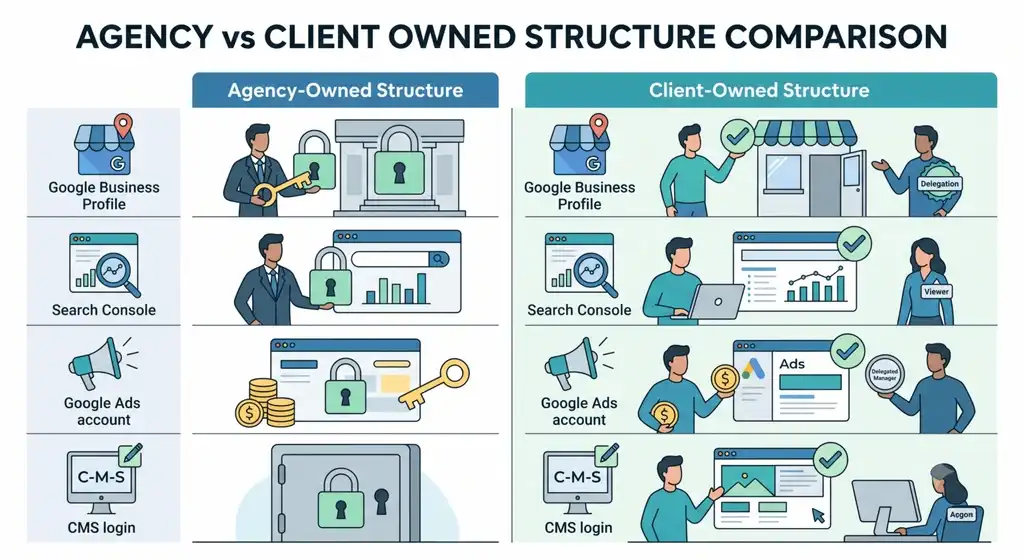
Some agencies open every account (Google Business Profile, Search Console, Google Ads, the CMS itself) under the client’s own organization from day one, with the agency holding delegated access that can be revoked in minutes. Others open these accounts under agency-owned logins or agency-managed sub-accounts, so that leaving means starting large parts of the technical foundation over.
Neither structure is illegal or unusual. It’s simply rarely disclosed upfront, because dependency is often the retention strategy. A guide on switching SEO providers without losing rankings or historical data confirms this is common enough to require its own transition playbook: businesses that switch providers can lose months or years of ranking history, campaign data, and account access if the handoff isn’t planned carefully.
This is the operating principle behind Tabula’s Marketing Ownership Framework: the system, the data, and the strategy stay with the business regardless of who’s running it day to day. Applied to SEO specifically, it means the ownership question isn’t a nice-to-have add-on to due diligence. It’s the first filter, because it determines whether every other answer in the vetting process is even worth trusting.
How to Tell if Your SEO Company Is Working (After You’ve Already Hired One)
If you’re past the hiring stage and want a read on whether your current vendor is actually delivering, check three things beyond the rank tracker screenshot they send you monthly:

- Access, not just reports. Log into Search Console and Google Business Profile yourself. If you can’t get in without asking, that’s the ownership gap showing up in real time.
- Traffic composition, not just position. A ranking that climbed but isn’t converting or isn’t matched to commercial intent is a vanity metric, not progress.
- Content you could defend. Read three recent pieces they’ve published for you. If none of it sounds like something your business would actually say, it’s generic output optimized for a keyword, not for your brand.
“Is hiring an SEO company worth it” and “how to tell if your SEO company is working” are really the same question asked at two different points in the relationship. Both come back to the same answer: worth it if you own what gets built, not worth it if you don’t.
Standard Vetting Questions to Ask an SEO Company
Once the ownership question is answered honestly, the rest of the standard checklist still matters. Ask:
- What specific accounts will be opened under my business’s name versus yours?
- Can I see de-identified before/after data from a client in a comparable industry, not just a logo wall?
- What’s included in the base engagement, and what becomes a paid add-on later?
- How often will I get a strategy call with a person, not just an automated report?
- What happens to my content calendar and keyword research if I pause the engagement?
- Do you have experience in my specific vertical, or a portfolio spread thin across every industry?
- What’s your average client tenure, and why do clients typically leave?
None of these questions are unusual. What’s unusual is asking them after you already know the answer to the ownership question, because it changes how much weight to give each response.
Should You Hire an SEO Company or Build the Skill In-House?
For businesses with the internal bandwidth to invest in training, building baseline SEO literacy on the existing team is a legitimate third option alongside hiring an agency or a freelancer. It won’t replace the technical depth a specialized SEO company brings to a competitive market, but it closes the gap where over-dependency causes the most damage: understanding enough about your own SEO performance to know if a vendor’s reporting is accurate. Running a basic SEO audit yourself before you hire anyone gives you a baseline to compare against whatever a vendor claims to have improved.
The Bottom Line
The standard “how to choose an SEO company” checklist isn’t wrong. It’s incomplete. Price, case studies, and communication style all matter, but none of them tell you what happens on the day the relationship ends, and every SEO engagement eventually ends, whether by choice or by contract expiration.
Ask the ownership question first. Let the answer set the tone for every other question that follows. An SEO company confident in its own work will answer it without hesitation, because they’re not counting on you staying trapped to keep the account.
If you’re evaluating a vendor right now, walk in and ask what you’d keep if you left tomorrow. The answer tells you more than a decade of case studies.
Want an SEO setup you actually own?
Tabula builds and runs SEO the same way, with every account, every asset, and every result staying in your name from day one.
See how Tabula’s SEO service works

Author
Carlos Rios
Carlos Rios is the Founder of Tabula. Before starting the agency, he spent his career inside companies — reporting to leaders who had no patience for vanity metrics and wanted straight answers about what was working and why. He built Tabula around that same standard: a marketing system the client owns, powered by AI and led by experts who explain the plan in plain language. Carlos studied philosophy for six years at York University and holds a Master's in Marketing from the Schulich School of Business.