

What Is E-E-A-T and Why Does It Matter for Your SMB Website in 2026?

Most small business owners discover E-E-A-T the same way: a website that was generating leads quietly drops to page three, and nobody can explain why. If you have already checked the basics — your site is indexed on Google, your Google Business Profile is optimised, and you are publishing content regularly — the answer is often that Google looked at your site and could not answer a basic question: why should we trust this?
E-E-A-T — Experience, Expertise, Authoritativeness, and Trustworthiness — is the quality framework Google’s human raters use to evaluate whether content deserves to rank. It is not a score, not a plugin, and not a single ranking factor. It is the lens through which Google reads your entire site, and in 2026, with AI Overviews now impacting organic traffic on nearly half of all searches, the threshold for passing that lens has risen sharply.
This guide breaks down what each signal actually means for an SMB, what Google’s quality raters are looking for when they land on your site, and the specific moves that build genuine trust — not cosmetic signals that Google’s systems see straight through.
E-E-A-T stands for Experience, Expertise, Authoritativeness, and Trustworthiness. Google uses it to evaluate content quality. For SMBs, the highest-leverage signals in 2026 are: first-hand experience demonstrated through case studies and real outcomes, cited credible sources, third-party mentions, and a technically transparent site. No plugin gives you E-E-A-T — it requires content that only a real expert could write.
What Does E-E-A-T Stand For?
E-E-A-T is an acronym from Google’s Search Quality Rater Guidelines — the document Google uses to train human evaluators who assess search result quality. The framework was originally called E-A-T (Expertise, Authoritativeness, Trustworthiness) until December 2022, when Google added a first E for Experience: the signal that has become the dominant differentiator in 2026.
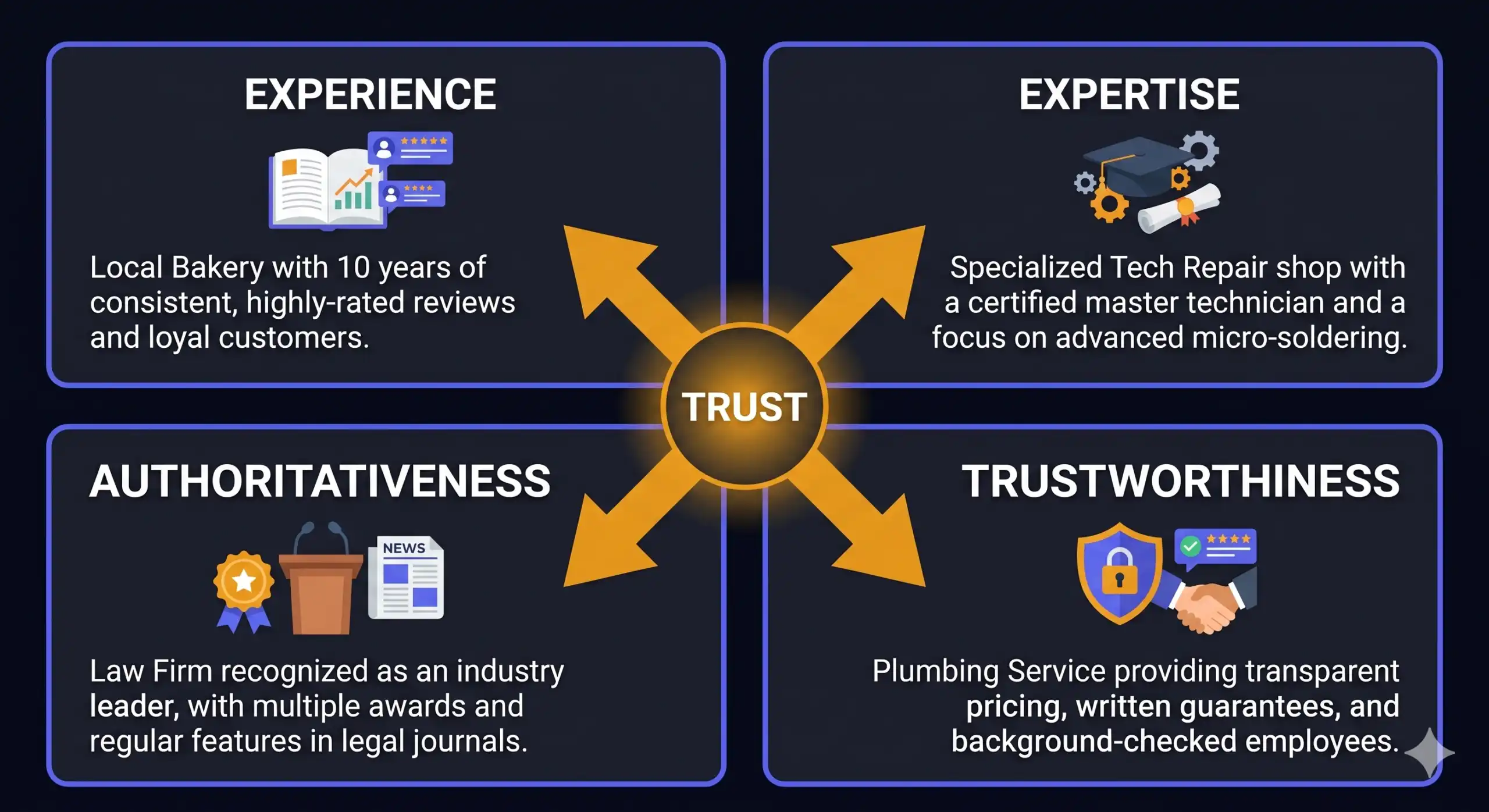
Here is what each component means in practice for a small business website:
| Signal | What It Measures | How SMBs Demonstrate It | 2026 Weight |
| Experience | First-hand proof you’ve done the thing | Case studies, before/after results, client outcomes with real numbers | Highest in 2026 |
| Expertise | Domain knowledge and credentials | Named author bio, industry data cited, professional background | High |
| Authoritativeness | Third-party recognition of your standing | Backlinks, press mentions, industry directory listings | High |
| Trustworthiness | Accuracy, transparency, security | Cited sources, no overclaiming, HTTPS, clear contact info | Foundation |
Trustworthiness is described in Google’s own guidelines as “the most important member of the E-E-A-T family.” A page with high expertise but low trust — a blog with no author credentials and no cited sources — will be rated poorly regardless of content depth. Understanding NLP keywords and how semantic relevance supports content quality is a related layer of the same picture.
Why E-E-A-T Matters More for SMBs Than Enterprise Brands
Large brands carry what Google calls reputation signals — press coverage, Wikipedia entries, high-authority backlinks — that function as implicit E-E-A-T scaffolding. When a recognisable brand publishes a new page, Google already has strong contextual evidence about its trustworthiness.
SMBs start from a different position. Without that pre-existing trust infrastructure, every page on your site has to earn its standing independently. The content itself must carry the proof. According to Google’s quality rater guidelines, the “overall reputation of the website and content creator” is evaluated separately from on-page content — which means a well-written page on a site with no reputation signals can still rank poorly.
The 2026 context compounds this further. AI Overviews are now impacting traffic across nearly half of all searches. For a significant portion of your target queries, Google’s AI system generates the first-level response — pulling exclusively from sources it has already assigned high trust to. Sites without strong E-E-A-T signals are not penalised. They are simply invisible to that selection process.
The Experience Signal: What Changed in 2022 (And Why It Now Defines Rankings)
When Google added the first E for Experience, it was codifying something its systems had already begun measuring: the difference between someone who knows about a topic and someone who has actually done the thing. Nick Fox, Google’s SVP of Knowledge and Information, stated this at Google Marketing Live 2026: “If you’re looking to buy something, you don’t just want to hear what the AI says. You want to hear someone that’s used it. What did they think? What went wrong with it? What was amazing about it?”
For SMBs, the Experience signal is a genuine competitive advantage over larger content teams. An agency producing 20 posts per week cannot replicate the specific, fallible, human detail of an owner who has worked through the problem they’re writing about. This is why writing a blog post that actually ranks in 2026 requires a fundamentally different brief than it did three years ago — generic coverage no longer clears the trust threshold.
How to Demonstrate Experience on an SMB Site
Experience signals are demonstrated through specificity, not volume. One post with a real client outcome, a named scenario, and a number attached to it outperforms ten generic guides. Concrete experience signals include:
- Client case studies with real numbers. “We helped a local accountancy firm increase organic leads by 41% in 90 days” is experience. “We help businesses grow” is not.
- Before/after comparisons with context. Describe the specific problem, the intervention, and the result — including what didn’t work the first time.
- Named scenarios. “When a flooring contractor in Manchester came to us” creates trust. “Many of our clients” does not.
- First-person author voice. Write from a named person’s perspective. Google’s quality raters are explicitly trained to look for the human behind the content.
Expertise, Authoritativeness, and Trustworthiness: What Google Is Actually Checking
Expertise
Expertise is demonstrated through the depth and accuracy of content, supported by the credentials of the person producing it. For most SMBs this means two things: naming the author and backing claims with primary sources. Google’s quality raters look for author bios, credentials, and professional affiliations. A blog post published under “Tabula Team” carries less expertise signal than one published by a named individual with a stated background and a linked LinkedIn profile.
On sourcing: every significant claim in your content should trace back to a primary source — official data, peer-reviewed research, or a direct quote from a named authority. Citing “studies show” without a link to the study is a trust liability, not a credibility signal.
Authoritativeness
Authoritativeness is the hardest signal for SMBs to build quickly because it is primarily off-page. It reflects how Google’s systems perceive your standing within your industry based on what others say about you — backlinks from relevant domains, mentions in industry publications, appearances in expert roundups. Tabula’s professional SEO services are built around developing exactly this kind of compounding off-site authority alongside on-page depth.
One lever available immediately: internal linking architecture. When a well-established page on your site links to a newer one, it passes contextual authority. Every post you publish should link to at least two others — the cluster structure signals to Google that a new page belongs in the same trusted topical group as your established content.
Trustworthiness
Trustworthiness is the foundation beneath the other three signals. For an SMB site, the trust signals quality raters check most consistently are:
- Contact information. A verifiable phone number, address, or contact form — especially critical for service businesses.
- Clear ownership. An about page that describes who runs the company, when it was founded, and what it does.
- Cited sources. External links to primary sources signal that you’re not asking visitors to take your claims on faith.
- Accurate claims. Overstating results or using unverified statistics are direct trust penalties in quality rater evaluations.
- HTTPS. A basic security requirement Google has treated as a ranking signal since 2014 — confirm it is correctly implemented across the full domain, particularly after a domain migration.
E-E-A-T Is Not a Score, a Tool, or a Plugin
The most common misconception about E-E-A-T is that it can be measured or “checked” by a tool. It cannot. Google has been explicit: there is no E-E-A-T score, no dedicated algorithm update, and no Semrush metric that reflects it directly.
What E-E-A-T is, operationally, is Google’s proxy for human quality judgement. The signals that contribute to it — author credentials, primary source citations, third-party reputation, on-page accuracy — are the same signals a thoughtful human editor would use to evaluate whether a website was worth recommending. A DIY SEO audit can surface technical gaps that undermine trust signals, but it cannot replace the editorial work required to build them.
The practical implication: any approach to “improving your E-E-A-T” that focuses on schema tags or keyword placement is treating a surface symptom. The underlying question is always would a knowledgeable human trust this content? Technical signals support that answer. They cannot substitute for it.
The YMYL Factor: When E-E-A-T Stakes Are Highest
Google applies its most rigorous E-E-A-T standards to YMYL content — Your Money or Your Life. These are topics where inaccurate information could harm a reader’s health, finances, safety, or wellbeing.
For SMBs, YMYL matters in two scenarios. First: if your business operates in a YMYL-adjacent space — a bookkeeper producing financial content, a nutritionist blogging about dietary plans, a tradesperson writing about building safety — Google applies a higher evidence burden than it would to a lifestyle brand. Second: any content that edges toward giving advice needs explicit credentialing. The safe approach: cite primary sources aggressively, state the limits of your advice clearly (“consult a qualified professional before…”), and ensure author credentials are prominently displayed and verifiable.
How to Build E-E-A-T for an SMB Website: A Practical Framework
There is no shortcut, but there is a logical sequence. Build in this order:
1. Establish Your Author Entity
Every piece of content should be attributed to a named human with a linked, complete author bio: full name, professional title, years of relevant experience, and any verifiable credentials. Google uses LinkedIn links to cross-reference claimed expertise against external evidence — an author who exists as a real entity on LinkedIn carries more authority than one who exists only on your site.
This principle extends beyond your blog. The named individual behind your brand voice on organic social media reinforces the human entity signal across channels, contributing to the off-site authority Google uses to corroborate on-page expertise claims.
2. Build a Case Study Library
Case studies are the highest-value E-E-A-T asset an SMB can produce — and the most systematically ignored content type. A single case study with real numbers signals Experience more powerfully than a hundred well-researched blog posts. They do not need to name the client. “A Bristol-based letting agency” with verifiable specifics is more credible than a vague “our client.”
The Build, Run, Train, Own methodology exists precisely because the systems your team builds produce the outcomes that become your most citable content. A case study embedded in a service page or blog post converts better than any testimonial, and it earns AI citation in a way that generic content cannot.
3. Earn Off-Site Entity Signals
Google evaluates your reputation across the web, not just on your site. Minimum viable off-site presence for credible E-E-A-T: a complete Google Business Profile, listings in relevant industry directories, and mentions in third-party publications — even local press or industry newsletters. See the full guide on optimising your Google Business Profile for the local trust signals that feed directly into E-E-A-T for service businesses.
4. Cite Sources Proactively
Every significant claim in your content should link to a primary source. Google’s quality raters are explicitly instructed to check whether factual claims are verifiable. Unverified stats are trust liabilities. Writing blog posts that rank in 2026 means treating source citation as a non-negotiable structural requirement — not an optional extra.
5. Audit Your Technical Trust Signals
E-E-A-T has a technical floor: HTTPS, no broken links, accurate structured data, and a clear site structure. A DIY SEO audit is a good starting point for identifying where your technical signals are degrading the trust you are building through content. For sites that have recently completed a domain migration, confirming that all redirects are correctly implemented via web development is a prerequisite — E-E-A-T signals need to accumulate on one canonical domain, not fragment across two.
E-E-A-T and AI Search: What Changes in 2026
The rise of AI Overviews changes the stakes of E-E-A-T without changing its principles. AI systems apply a version of the same trust framework Google has always used — they prefer sources with demonstrated expertise, third-party validation, and content that contains specific, verifiable claims.
What is new in 2026 is the visibility threshold. AI Overviews handle the first-level response — definitions, summaries, simple how-tos. Content that lives only at that level is increasingly invisible: the AI provides the surface answer, the click never happens. The content that earns both the AI citation and the organic click is content that goes one level deeper — to the specific outcome, the edge case, the thing that only happened because a human was in the room.
For E-E-A-T, this means the Experience signal is not just a quality indicator — it is an AI visibility lever. The human detail that AI systems cannot generate is precisely what they must surface from external sources. That is the competitive advantage of an SMB owner who has genuinely done the work and is willing to document it specifically.
E-E-A-T: Common Questions
Does E-E-A-T directly affect my rankings?
Not as a direct ranking factor, but as a quality evaluator that shapes how Google’s systems rate your content over time. Pages rated highly by quality raters tend to rank better because rater assessments inform algorithm training. Improving your E-E-A-T signals improves your ranking probability — particularly in competitive niches and YMYL-adjacent topics. If your site is not showing up on Google despite publishing content, weak E-E-A-T signals are one of the most common root causes.
Can I improve E-E-A-T quickly?
Some signals improve immediately: adding a credentialled author bio, citing primary sources, completing your contact information. Others take time: building a case study library, earning third-party mentions, developing topical authority through a content cluster. The fastest material change for most SMB sites is the author entity — named, credentialled, linked to LinkedIn, attached to every post. If you are unsure where your gaps are, a DIY SEO audit is a practical starting point.
Does E-E-A-T apply differently to local businesses?
Yes. For local service businesses, Google Business Profile completeness, consistent NAP (name, address, phone) information across the web, and genuine customer reviews function as primary E-E-A-T signals. A well-maintained GBP with specific, detailed client reviews carries significant trust weight for local queries. See the full guide on optimising your Google Business Profile for the complete local trust checklist.
What is the single most impactful E-E-A-T fix for an SMB?
Add a named, credentialled author to every content piece, with a complete bio and a link to a verifiable professional profile. This single change addresses the Experience, Expertise, and Trustworthiness signals simultaneously, and it is the most common gap found when auditing SMB sites with strong technical performance but weak ranking outcomes. Pair it with Tabula’s professional SEO services if you want the full authority-building system built around it.
The Bottom Line
E-E-A-T is not a checklist item — it is the answer to the question Google asks every time it decides whether your content is worth showing to someone. The brands that build genuine trust signals — named authors, real outcomes, cited sources, verifiable off-site presence — are the ones whose content survives algorithm updates, earns AI citations, and continues generating traffic years after publication.
The brands that treat E-E-A-T as a cosmetic exercise — credentials with no linked verification, stats with no sources, case studies with no specifics — are building on sand. If you have questions about how this applies to your specific site, the FAQs cover the most common scenarios, or book a direct review below.
Ready to Build a Website Google Actually Trusts?
Most SMB sites have three to five fixable E-E-A-T gaps holding back their organic performance. A Tabula site review identifies exactly where those gaps are and what to do about them — no jargon, no guesswork, just a clear action list.
Book a free site review: Get in Touch

Author
Carlos Rios
Carlos Rios is the Founder of Tabula. Before starting the agency, he spent his career inside companies — reporting to leaders who had no patience for vanity metrics and wanted straight answers about what was working and why. He built Tabula around that same standard: a marketing system the client owns, powered by AI and led by experts who explain the plan in plain language. Carlos studied philosophy for six years at York University and holds a Master's in Marketing from the Schulich School of Business.